
Join Our JEE Preparation Group
Prep with like-minded aspirants; Get access to free daily tests and study material.
Sign in
Please select an account to continue using cracku.in
↓ →
Join Our JEE Preparation Group
Prep with like-minded aspirants; Get access to free daily tests and study material.
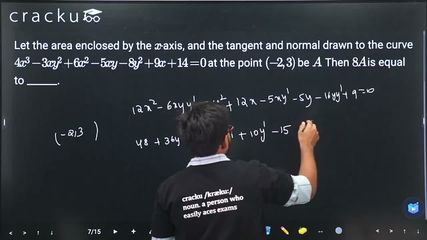
Let the area enclosed by the $$x$$-axis, and the tangent and normal drawn to the curve $$4x^3 - 3xy^2 + 6x^2 - 5xy - 8y^2 + 9x + 14 = 0$$ at the point $$(-2, 3)$$ be $$A$$. Then $$8A$$ is equal to ______.
Correct Answer: 170
We need to find the area enclosed by the $$x$$-axis, and the tangent and normal to the curve $$4x^3 - 3xy^2 + 6x^2 - 5xy - 8y^2 + 9x + 14 = 0$$ at $$(-2, 3)$$.
Verifying that the point $$(-2, 3)$$ lies on the curve gives:
$$4(-8) - 3(-2)(9) + 6(4) - 5(-2)(3) - 8(9) + 9(-2) + 14 = -32 + 54 + 24 + 30 - 72 - 18 + 14 = 0 \checkmark$$
Implicit differentiation of the curve yields:
$$12x^2 - 3y^2 - 6xyy' + 12x - 5y - 5xy' - 16yy' + 9 = 0$$
$$y'(-6xy - 5x - 16y) = -12x^2 + 3y^2 - 12x + 5y - 9$$
Substituting $$(-2, 3)$$ into this gives
$$y'(36 + 10 - 48) = -48 + 27 + 24 + 15 - 9$$
$$y'(-2) = 9 \implies y' = -\frac{9}{2}$$
The tangent line at $$(-2, 3)$$ has slope $$-\frac{9}{2}$$ and is given by
$$y - 3 = -\frac{9}{2}(x + 2) \implies 9x + 2y + 12 = 0$$
Its $$x$$-intercept (set $$y = 0$$) is $$x = -\frac{4}{3}$$, yielding the point $$\left(-\frac{4}{3}, 0\right)$$.
The normal line at $$(-2, 3)$$ has slope $$\frac{2}{9}$$ and is given by
$$y - 3 = \frac{2}{9}(x + 2) \implies 2x - 9y + 31 = 0$$
Its $$x$$-intercept (set $$y = 0$$) is $$x = -\frac{31}{2}$$, yielding the point $$\left(-\frac{31}{2}, 0\right)$$.
The triangle formed by the points $$(-2, 3)$$, $$\left(-\frac{4}{3}, 0\right)$$, and $$\left(-\frac{31}{2}, 0\right)$$ has a base along the $$x$$-axis of length $$\left|-\frac{4}{3} + \frac{31}{2}\right| = \left|\frac{-8 + 93}{6}\right| = \frac{85}{6}$$ and a height of $$3$$.
Thus $$A = \frac{1}{2} \times \frac{85}{6} \times 3 = \frac{85}{4}$$, and hence $$8A = 8 \times \frac{85}{4} = 170$$.
The answer is $$\boxed{170}$$.
Was this solution helpful?
Click on the Email ☝️ to Watch the Video Solution
Create a FREE account and get:
_1.webp)

Educational materials for JEE preparation

Ask our AI anything

AI can make mistakes. Please verify important information.
AI can make mistakes. Please verify important information.
