
Join Our JEE Preparation Group
Prep with like-minded aspirants; Get access to free daily tests and study material.
Sign in
Please select an account to continue using cracku.in
↓ →
Join Our JEE Preparation Group
Prep with like-minded aspirants; Get access to free daily tests and study material.
Let $$P(x)$$ be a real polynomial of degree 3 which vanishes at $$x = -3$$. Let $$P(x)$$ have local minima at $$x = -1$$, local maxima at $$x = 1$$ and $$\int_{-1}^{1} P(x)dx = 18$$, then the sum of all the coefficients of the polynomial $$P(x)$$ is equal to ___.
Correct Answer: 8
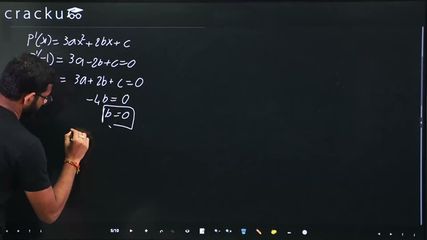
Let $$P(x) = ax^3 + bx^2 + cx + d$$ be a cubic polynomial with $$P(-3) = 0$$. Since $$P$$ has a local minimum at $$x = 1$$ and a local maximum at $$x = -1$$, we need $$P'(1) = 0$$ and $$P'(-1) = 0$$, where $$P'(x) = 3ax^2 + 2bx + c$$.
From $$P'(1) = 3a + 2b + c = 0$$ and $$P'(-1) = 3a - 2b + c = 0$$, subtracting gives $$4b = 0$$, so $$b = 0$$. Then $$c = -3a$$. With $$b = 0$$, the polynomial is $$P(x) = ax^3 - 3ax + d$$.
Applying $$P(-3) = 0$$: $$a(-27) - 3a(-3) + d = -27a + 9a + d = -18a + d = 0$$, so $$d = 18a$$. Thus $$P(x) = a(x^3 - 3x + 18)$$.
Now we use $$\int_{-1}^{1}P(x)\,dx = 18$$. Since $$x^3$$ and $$x$$ are odd functions, their integrals over $$[-1,1]$$ vanish, leaving $$\int_{-1}^{1}18a\,dx = 18a \cdot 2 = 36a = 18$$, giving $$a = \dfrac{1}{2}$$.
The sum of all coefficients of $$P(x)$$ is $$P(1) = \dfrac{1}{2}(1 - 3 + 18) = \dfrac{16}{2} = 8$$.
Was this solution helpful?
Click on the Email ☝️ to Watch the Video Solution
Create a FREE account and get:
_1.webp)

Educational materials for JEE preparation

Ask our AI anything

AI can make mistakes. Please verify important information.
AI can make mistakes. Please verify important information.
