
Join Our JEE Preparation Group
Prep with like-minded aspirants; Get access to free daily tests and study material.
Sign in
Please select an account to continue using cracku.in
↓ →
Join Our JEE Preparation Group
Prep with like-minded aspirants; Get access to free daily tests and study material.
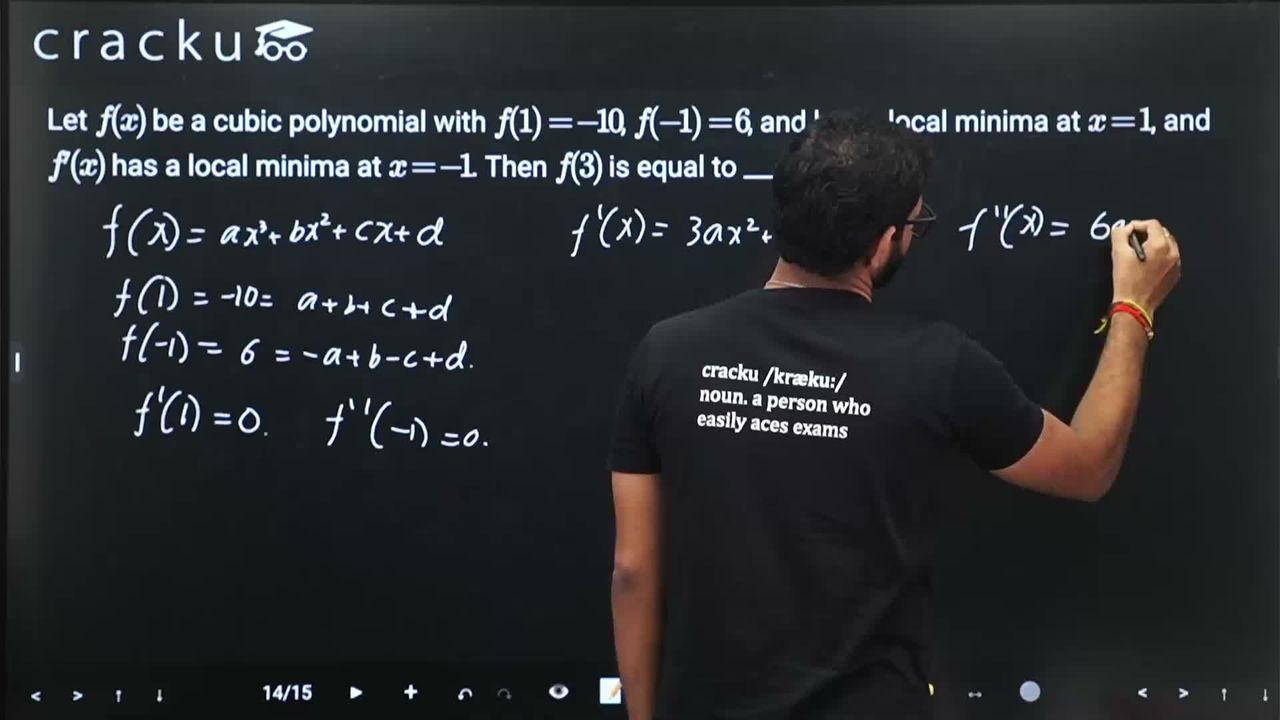
Let $$f(x)$$ be a cubic polynomial with $$f(1) = -10$$, $$f(-1) = 6$$, and has a local minima at $$x = 1$$, and $$f'(x)$$ has a local minima at $$x = -1$$. Then $$f(3)$$ is equal to _________.
Correct Answer: 22
Let us assume that the required cubic polynomial is of the general form
$$f(x)=ax^{3}+bx^{2}+cx+d,$$
where $$a,\;b,\;c,\;d$$ are real constants that we have to determine.
We are given the two functional values
$$f(1)=-10 \quad\text{and}\quad f(-1)=6.$$
We are also told that the function has a local minimum at $$x=1$$. For a local extremum we know the basic calculus fact that
$$f'(x)=0 \quad\text{at that point.}$$
So we first compute the derivative:
$$f'(x)=\frac{d}{dx}\bigl(ax^{3}+bx^{2}+cx+d\bigr)=3ax^{2}+2bx+c.$$
Using the extremum condition at $$x=1$$, we write
$$f'(1)=3a(1)^{2}+2b(1)+c=3a+2b+c=0.$$ So we obtain our first equation
$$3a+2b+c=0.\qquad(1)$$
Next, we are told that $$f'(x)$$ itself (which is a quadratic) has a local minimum at $$x=-1$$. Again applying the same extremum rule to $$f'(x)$$, we differentiate once more:
$$f''(x)=\frac{d}{dx}\bigl(3ax^{2}+2bx+c\bigr)=6ax+2b.$$
A local extremum of $$f'(x)$$ at $$x=-1$$ means
$$f''(-1)=0.$$
Substituting $$x=-1$$ in the expression of $$f''(x)$$ we get
$$6a(-1)+2b=0\;\Longrightarrow\;-6a+2b=0.$$
Simplifying, we arrive at
$$2b=6a \;\Longrightarrow\; b=3a.\qquad(2)$$
Now we return to equation (1) and replace $$b$$ with $$3a$$ from equation (2):
$$3a+2(3a)+c=0 \;\Longrightarrow\; 3a+6a+c=0 \;\Longrightarrow\; 9a+c=0.$$
Thus we get
$$c=-9a.\qquad(3)$$
We have expressed $$b$$ and $$c$$ in terms of $$a$$. The constant $$d$$ can be found from the given value $$f(1)=-10$$. Substituting $$x=1$$ in the general expression of $$f(x)$$, we have
$$f(1)=a(1)^{3}+b(1)^{2}+c(1)+d=a+b+c+d=-10.$$
Replacing $$b$$ and $$c$$ by their expressions from (2) and (3):
$$a+3a-9a+d=-10.$$
Combining like terms,
$$(-5a)+d=-10 \;\Longrightarrow\; d=-10+5a.\qquad(4)$$
The last given condition is $$f(-1)=6.$$ Putting $$x=-1$$ into $$f(x)$$ gives
$$f(-1)=a(-1)^{3}+b(-1)^{2}+c(-1)+d=-a+b-c+d=6.$$
Again substitute $$b=3a,\;c=-9a,\;d=-10+5a$$:
$$-a+3a-(-9a)+(-10+5a)=6.$$
Observe that $$-(-9a)=+9a$$, so the left-hand side simplifies to
$$(-a+3a+9a+5a)-10 = (16a)-10.$$
Hence we get
$$16a-10=6 \;\Longrightarrow\; 16a=16 \;\Longrightarrow\; a=1.$$
With $$a=1$$ known, the remaining coefficients follow:
$$b=3a=3,\quad c=-9a=-9,\quad d=-10+5a=-10+5=-5.$$
Therefore the fully determined cubic polynomial is
$$f(x)=x^{3}+3x^{2}-9x-5.$$
Finally, we are asked to compute $$f(3)$$. Substituting $$x=3$$ gives
$$f(3)=3^{3}+3\cdot3^{2}-9\cdot3-5=27+27-27-5.$$
Combining term by term,
$$27+27=54,\qquad 54-27=27,\qquad 27-5=22.$$
So, the answer is $$22$$.
Click on the Email ☝️ to Watch the Video Solution
Create a FREE account and get:
_1.webp)

Educational materials for JEE preparation

Ask our AI anything

AI can make mistakes. Please verify important information.
AI can make mistakes. Please verify important information.


