
Join Our JEE Preparation Group
Prep with like-minded aspirants; Get access to free daily tests and study material.
Sign in
Please select an account to continue using cracku.in
↓ →
Join Our JEE Preparation Group
Prep with like-minded aspirants; Get access to free daily tests and study material.
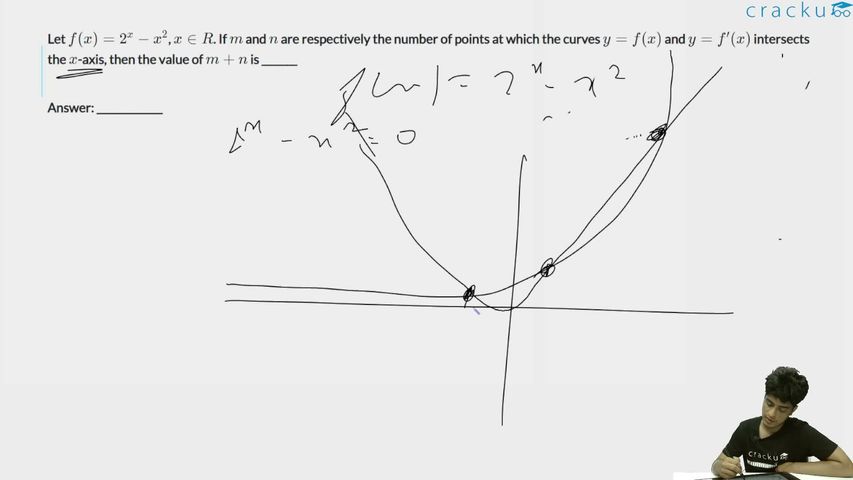
Let $$f(x) = 2^x - x^2$$, $$x \in R$$. If $$m$$ and $$n$$ are respectively the number of points at which the curves $$y = f(x)$$ and $$y = f'(x)$$ intersects the $$x$$-axis, then the value of $$m + n$$ is _______
Correct Answer: 5
We need the number of real roots of the equations
$$f(x)=0 \quad\Longleftrightarrow\quad 2^{x}=x^{2}$$
$$f'(x)=0 \quad\Longleftrightarrow\quad 2^{x}\,\ln 2=2x$$
Case 1: Points where $$y=f(x)$$ cuts the $$x$$-axis (roots of $$f(x)$$)
Define $$g(x)=2^{x}-x^{2}\;.$$ We inspect its sign in different regions.
• As $$x\rightarrow -\infty$$, $$2^{x}\rightarrow 0$$ while $$x^{2}\rightarrow \infty$$, so $$g(x)\rightarrow-\infty\;(\text{negative}).$$
• $$g(0)=2^{0}-0^{2}=1 \gt 0$$ (positive).
• $$g(-1)=2^{-1}-(-1)^{2}=0.5-1=-0.5 \lt 0$$ (negative). Because $$g(-1)\lt 0$$ and $$g(0)\gt 0$$, by the Intermediate Value Theorem there is one root in $$(-1,0)$$.
• $$g(2)=2^{2}-2^{2}=0$$ and $$g(4)=2^{4}-4^{2}=0$$. A quick check of the sign between these points: $$g(3)=2^{3}-3^{2}=8-9=-1\lt 0,$$ so the function changes sign at both $$x=2$$ and $$x=4$$ but not again between them.
• For $$x\gt 4$$, the exponential term dominates: $$g(6)=2^{6}-6^{2}=64-36=28\gt 0$$ and the value keeps increasing, so no more zeros occur.
Hence the three distinct real roots are
one in $$(-1,0)$$, and the obvious ones $$x=2$$ and $$x=4$$.
Therefore $$m=3$$.
Case 2: Points where $$y=f'(x)$$ cuts the $$x$$-axis (roots of $$f'(x)$$)
Differentiate: $$f'(x)=2^{x}\ln 2-2x.$$ Let
$$h(x)=2^{x}\ln 2-2x.$$
• $$h(0)=\ln 2\;(\approx0.693)\gt0.$$
• As $$x\rightarrow -\infty$$: $$2^{x}\ln 2\rightarrow 0$$ and $$-2x\rightarrow+\infty,$$ hence $$h(x)\rightarrow+\infty\;(\text{positive}).$$
• Evaluate at $$x=1$$: $$h(1)=2\ln 2-2\approx1.386-2=-0.614\lt0.$$ So a sign change occurs between $$x=0$$ and $$x=1$$ ⇒ one root in $$(0,1).$$
• To check for more roots, find extrema of $$h(x)$$:
$$h'(x)=2^{x}(\ln 2)^{2}-2.$$
Set $$h'(x)=0$$: $$2^{x}=\dfrac{2}{(\ln 2)^{2}}\approx4.166\;,$$ giving
$$x_{0}=\log_{2}(4.166)\approx2.06.$$
Because $$h''(x)=2^{x}(\ln 2)^{3}\gt0,$$ this point is the unique minimum of $$h(x).$$
• Value at the minimum: $$h(2.06)=2^{2.06}\ln 2-2(2.06)\approx2.888-4.12\approx-1.23\lt0.$$ Thus $$h(x)$$ is negative in a neighborhood of this minimum.
• Check farther right: $$h(4)=2^{4}\ln 2-8=16\ln 2-8\approx11.09-8=3.09\gt0.$$ So $$h(x)$$ changes from negative to positive between $$x\approx3$$ and $$x=4$$, giving a second root in $$(3,4).$$
• Since $$h(x)$$ is positive for $$x\lt0$$ and again for sufficiently large $$x\gt4$$, and has only one minimum, no additional sign changes are possible.
Hence $$h(x)=0$$ has exactly two real solutions, so $$n=2$$.
Finally, $$m+n=3+2=5$$.
Answer : 5
Was this solution helpful?
Click on the Email ☝️ to Watch the Video Solution
Create a FREE account and get:
_1.webp)

Educational materials for JEE preparation

Ask our AI anything

AI can make mistakes. Please verify important information.
AI can make mistakes. Please verify important information.
