
Join Our JEE Preparation Group
Prep with like-minded aspirants; Get access to free daily tests and study material.
Sign in
Please select an account to continue using cracku.in
↓ →
Join Our JEE Preparation Group
Prep with like-minded aspirants; Get access to free daily tests and study material.
Let $$f : R \to R$$ be a function defined $$f(x) = \frac{2e^{2x}}{e^{2x}+e}$$. Then $$f\left(\frac{1}{100}\right) + f\left(\frac{2}{100}\right) + f\left(\frac{3}{100}\right) + \ldots + f\left(\frac{99}{100}\right)$$ is equal to ______
Correct Answer: 99
We are given $$f(x) = \frac{2e^{2x}}{e^{2x} + e}$$ and asked to find $$\sum_{k=1}^{99} f\left(\frac{k}{100}\right)$$.
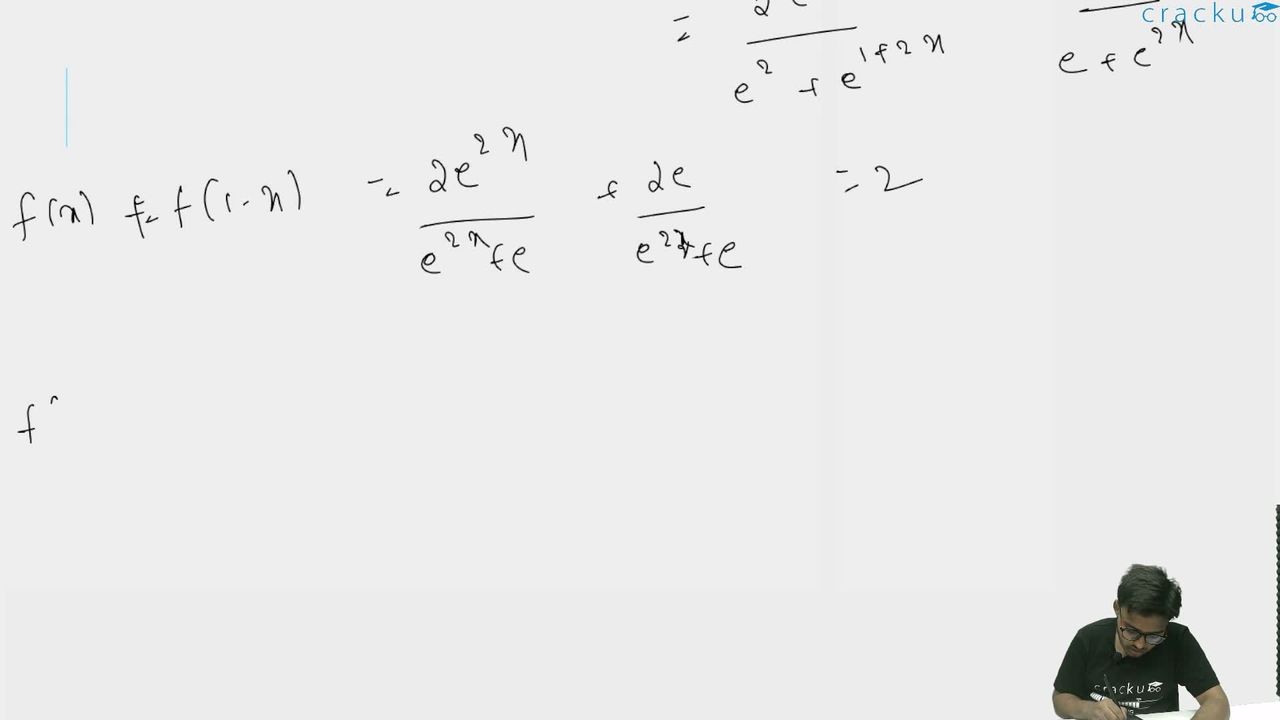
Since $$f(x) = \frac{2e^{2x}}{e^{2x} + e} = \frac{2e^{2x}}{e(e^{2x-1} + 1)} = \frac{2e^{2x-1}}{e^{2x-1} + 1}$$, it is natural to examine the sum $$f(x) + f(1-x)$$.
We have $$f(1-x) = \frac{2e^{2(1-x)-1}}{e^{2(1-x)-1} + 1} = \frac{2e^{1-2x}}{e^{1-2x} + 1}$$. Consequently,
$$f(x) + f(1-x) = \frac{2e^{2x-1}}{e^{2x-1} + 1} + \frac{2e^{1-2x}}{e^{1-2x} + 1}$$.
To combine these two terms, we multiply the numerator and denominator of the second fraction by $$e^{2x-1}$$, yielding
$$\frac{2e^{1-2x} \cdot e^{2x-1}}{(e^{1-2x}+1) \cdot e^{2x-1}} = \frac{2}{1 + e^{2x-1}}$$. Therefore,
$$f(x) + f(1-x) = \frac{2e^{2x-1}}{e^{2x-1}+1} + \frac{2}{e^{2x-1}+1} = \frac{2(e^{2x-1}+1)}{e^{2x-1}+1} = 2$$.
Using this symmetry, each pair
$$f\left(\frac{k}{100}\right) + f\left(\frac{100-k}{100}\right) = 2$$ for each $$k$$. The sum from $$k = 1$$ to $$99$$ can be paired as $$(k=1, k=99), (k=2, k=98), \ldots, (k=49, k=51)$$ — that gives 49 pairs, plus the middle term $$k = 50$$.
Each pair sums to 2, so 49 pairs give $$49 \times 2 = 98$$.
Moreover,
$$f\left(\frac{50}{100}\right) = f\left(\frac{1}{2}\right) = \frac{2e^0}{e^0 + 1} = \frac{2}{2} = 1$$.
Adding these contributions together gives
$$S = 98 + 1 = 99$$.
The answer is $$\boxed{99}$$.
Was this solution helpful?
Click on the Email ☝️ to Watch the Video Solution
Create a FREE account and get:
_1.webp)

Educational materials for JEE preparation

Ask our AI anything

AI can make mistakes. Please verify important information.
AI can make mistakes. Please verify important information.
