
Join Our JEE Preparation Group
Prep with like-minded aspirants; Get access to free daily tests and study material.
Sign in
Please select an account to continue using cracku.in
↓ →
Join Our JEE Preparation Group
Prep with like-minded aspirants; Get access to free daily tests and study material.
If an angle between the line, $$\frac{x+1}{2} = \frac{y-2}{1} = \frac{z-3}{-2}$$ and the plane, $$x - 2y - kz = 3$$ is $$\cos^{-1}\left(\frac{2\sqrt{2}}{3}\right)$$, then a value of k is
We begin by identifying the direction vector of the given line and the normal vector of the given plane.
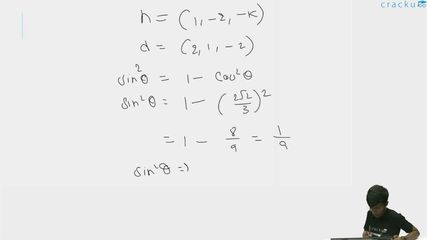
The symmetric equations of the line are $$\dfrac{x+1}{2}=\dfrac{y-2}{1}=\dfrac{z-3}{-2}\,,$$ so the direction vector of the line is $$\vec d = \langle 2,\,1,\,-2\rangle.$$
The plane is $$x-2y-kz=3\,,$$ whose normal vector is $$\vec n = \langle 1,\,-2,\,-k\rangle.$$
The angle between a line and a plane is defined as the complement of the angle between the line’s direction vector and the plane’s normal vector. A standard result states:
For an angle $$\theta$$ between the line and the plane, $$\sin\theta=\dfrac{|\vec n\cdot\vec d|}{\|\vec n\|\,\|\vec d\|}.$$
In the problem, this angle satisfies $$\theta=\cos^{-1}\!\left(\dfrac{2\sqrt2}{3}\right)\,,$$ so we first convert the given cosine value into sine:
We have $$\cos\theta=\dfrac{2\sqrt2}{3}\,.$$
Using $$\sin^2\theta+\cos^2\theta=1,$$ we get
$$\sin\theta=\sqrt{1-\cos^2\theta} =\sqrt{1-\left(\dfrac{2\sqrt2}{3}\right)^2} =\sqrt{1-\dfrac{8}{9}} =\sqrt{\dfrac{1}{9}} =\dfrac13.$$
Now we compute each quantity that appears in the formula for $$\sin\theta$$.
The dot product of the two vectors is
$$\vec n\cdot\vec d =\langle 1,\,-2,\,-k\rangle\cdot\langle 2,\,1,\,-2\rangle =1\cdot2+(-2)\cdot1+(-k)\cdot(-2) =2-2+2k =2k.$$
Taking its magnitude, $$|\vec n\cdot\vec d|=|2k|=2|k|.$$
The magnitudes of the individual vectors are
$$\|\vec d\|=\sqrt{2^2+1^2+(-2)^2}=\sqrt{4+1+4}=3,$$
$$\|\vec n\|=\sqrt{1^2+(-2)^2+(-k)^2}=\sqrt{1+4+k^2}=\sqrt{k^2+5}.$$
Substituting everything into the formula $$\sin\theta=\dfrac{|\vec n\cdot\vec d|}{\|\vec n\|\,\|\vec d\|},$$ we obtain
$$\dfrac13=\dfrac{2|k|}{\sqrt{k^2+5}\,\cdot\,3}.$$
Multiplying both sides by $$3$$ eliminates the common factor:
$$1=\dfrac{2|k|}{\sqrt{k^2+5}}.$$
Now multiply both sides by $$\sqrt{k^2+5}$$:
$$\sqrt{k^2+5}=2|k|.$$
Next, we square both sides to clear the square root (this automatically handles the absolute value):
$$k^2+5=4k^2.$$
Rearranging terms gives
$$4k^2-k^2=5 \;\Longrightarrow\;3k^2=5 \;\Longrightarrow\;k^2=\dfrac53.$$
Taking square roots, we find
$$k=\pm\sqrt{\dfrac53}.$$
Among the options, $$\sqrt{\dfrac53}$$ appears as Option A. (The negative root is not listed among the given choices.)
Hence, the correct answer is Option A.
Was this solution helpful?
Click on the Email ☝️ to Watch the Video Solution
Create a FREE account and get:
_1.webp)

Educational materials for JEE preparation

Ask our AI anything

AI can make mistakes. Please verify important information.
AI can make mistakes. Please verify important information.


