
Join Our JEE Preparation Group
Prep with like-minded aspirants; Get access to free daily tests and study material.
Sign in
Please select an account to continue using cracku.in
↓ →
Join Our JEE Preparation Group
Prep with like-minded aspirants; Get access to free daily tests and study material.
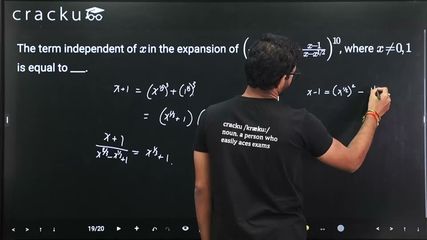
The term independent of $$x$$ in the expansion of $$\left(\frac{x+1}{x^{2/3} - x^{1/3} + 1} - \frac{x-1}{x - x^{1/2}}\right)^{10}$$, where $$x \neq 0, 1$$ is equal to ___.
Correct Answer: 210
We begin by observing the expression inside the large parenthesis:
$$\frac{x+1}{x^{2/3}-x^{1/3}+1}-\frac{x-1}{\,x-x^{1/2}\,}.$$
Our aim is to simplify this inner expression first, because after simplification we will raise it to the 10-th power and then locate the term that is independent of $$x$$.
Let us tackle the first fraction. Put $$x=y^{3}$$, so that $$x^{1/3}=y$$. Then
$$x^{2/3}-x^{1/3}+1=y^{2}-y+1,$$ $$x+1=y^{3}+1=(y+1)(y^{2}-y+1).$$
Hence
$$\frac{x+1}{x^{2/3}-x^{1/3}+1}=\frac{(y+1)(y^{2}-y+1)}{y^{2}-y+1}=y+1 =x^{1/3}+1.$$
Now consider the second fraction. Put $$x=z^{2}$$, so that $$x^{1/2}=z$$. Then
$$x-x^{1/2}=z^{2}-z=z(z-1),$$ $$x-1=z^{2}-1=(z-1)(z+1).$$
Therefore
$$\frac{x-1}{\,x-x^{1/2}\,}=\frac{(z-1)(z+1)}{z(z-1)}=\frac{z+1}{z}=1+\frac1z =1+x^{-1/2}.$$
Combining the two simplified parts we have
$$\left(\frac{x+1}{x^{2/3}-x^{1/3}+1}-\frac{x-1}{\,x-x^{1/2}\,}\right) =(x^{1/3}+1)-(1+x^{-1/2})=x^{1/3}-x^{-1/2}.$$
Thus the original problem reduces to expanding
$$(x^{1/3}-x^{-1/2})^{10}.$$
We now apply the Binomial Theorem, which states:
For any real numbers $$a,\,b$$ and a non-negative integer $$n$$, $$(a+b)^{n}=\displaystyle\sum_{k=0}^{n}\binom{n}{k}a^{\,n-k}b^{\,k}.$$
Here $$a=x^{1/3}$$, $$b=-x^{-1/2}$$, and $$n=10$$. The general term is therefore
$$T_{k}=\binom{10}{k}(x^{1/3})^{\,10-k}\bigl(-x^{-1/2}\bigr)^{k} =\binom{10}{k}(-1)^{k}\,x^{\frac{10-k}{3}-\frac{k}{2}}.$$
The power of $$x$$ in this term is
$$\frac{10-k}{3}-\frac{k}{2}.$$
For a term to be independent of $$x$$, this exponent must be zero. Hence we solve
$$\frac{10-k}{3}-\frac{k}{2}=0.$$
Multiplying by the common denominator $$6$$, we get
$$2(10-k)-3k=0\;\;\Longrightarrow\;\;20-2k-3k=0 \;\;\Longrightarrow\;\;20-5k=0 \;\;\Longrightarrow\;\;k=4.$$
So the required term arises when $$k=4$$. Substituting $$k=4$$ into the general term we obtain
$$T_{4}=\binom{10}{4}(-1)^{4}\,x^{\frac{10-4}{3}-\frac{4}{2}} =\binom{10}{4}(+1)\,x^{\;2-2}= \binom{10}{4}\,x^{0}.$$
But $$\binom{10}{4}=210$$, and $$x^{0}=1$$, so
$$T_{4}=210.$$
Therefore, the term independent of $$x$$ in the expansion is $$210$$.
So, the answer is $$210$$.
Was this solution helpful?
Click on the Email ☝️ to Watch the Video Solution
Create a FREE account and get:
_1.webp)

Educational materials for JEE preparation

Ask our AI anything

AI can make mistakes. Please verify important information.
AI can make mistakes. Please verify important information.
