
Join Our JEE Preparation Group
Prep with like-minded aspirants; Get access to free daily tests and study material.
Sign in
Please select an account to continue using cracku.in
↓ →
Join Our JEE Preparation Group
Prep with like-minded aspirants; Get access to free daily tests and study material.
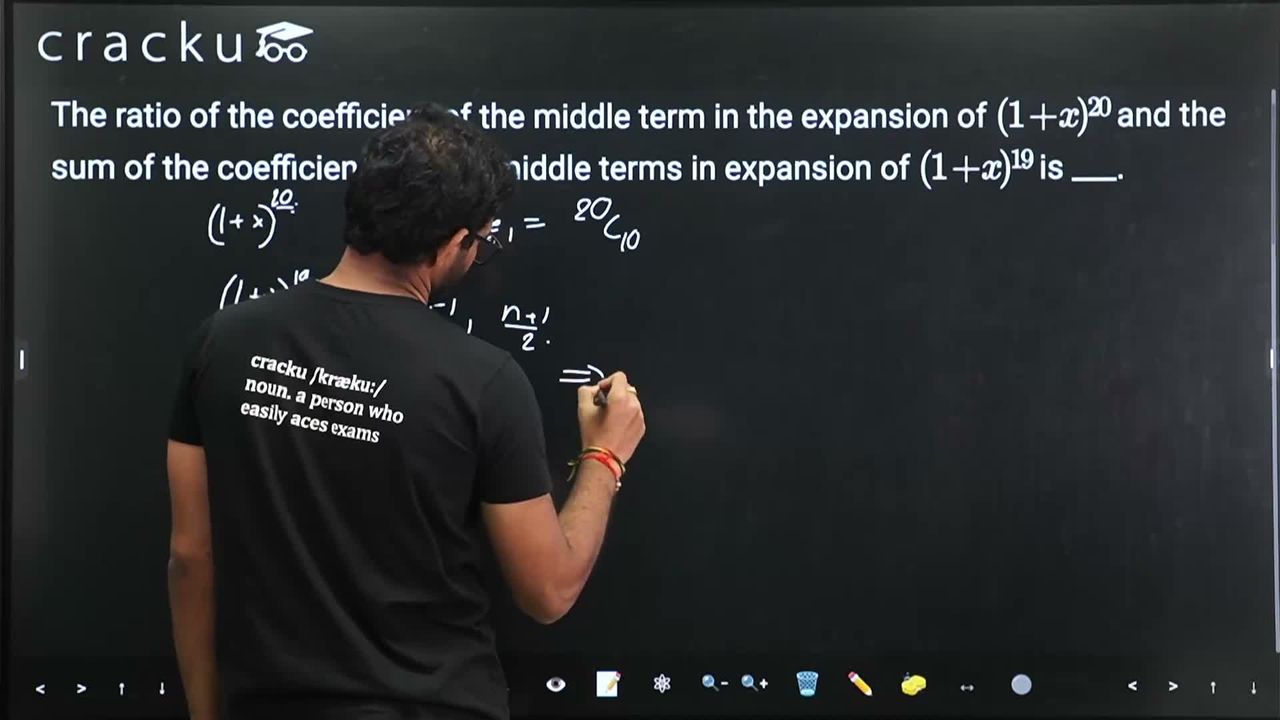
The ratio of the coefficient of the middle term in the expansion of $$(1+x)^{20}$$ and the sum of the coefficients of two middle terms in expansion of $$(1+x)^{19}$$ is ___.
Correct Answer: 1
We begin with the standard Binomial Theorem, which states that for any non-negative integer $$n$$,
$$ (1+x)^n \;=\; \sum_{r=0}^{n} {\,}^{n}C_{r}\,x^{\,r}, $$
where $${\,}^{n}C_{r} = \dfrac{n!}{r!\,(n-r)!}$$ is the binomial coefficient.
First we look at $$(1+x)^{20}$$. Because the exponent $$20$$ is even, there is just one middle term in its expansion. For an even exponent $$n$$, the unique middle term corresponds to
$$ r \;=\; \dfrac{n}{2}. $$
Putting $$n = 20$$ gives
$$ r \;=\; \dfrac{20}{2} = 10. $$
Therefore the middle term in $$(1+x)^{20}$$ is the term with $$r = 10$$, and its coefficient is
$$ {\,}^{20}C_{10} \;=\; \dfrac{20!}{10!\,10!}. $$
Next we examine $$(1+x)^{19}$$. Since $$19$$ is odd, there are two middle terms. For an odd exponent $$n$$, the two middle terms occur at
$$ r_1 \;=\; \dfrac{n-1}{2}, \qquad r_2 \;=\; \dfrac{n+1}{2}. $$
Substituting $$n = 19$$ we obtain
$$$ r_1 = \dfrac{19-1}{2} = 9, \qquad r_2 = \dfrac{19+1}{2} = 10. $$$
Thus the two middle coefficients in $$(1+x)^{19}$$ are
$$ {\,}^{19}C_{9} \quad\text{and}\quad {\,}^{19}C_{10}. $$
Because binomial coefficients satisfy the symmetry property $${\,}^{n}C_{r} = {\,}^{n}C_{n-r},$$ we have
$$ {\,}^{19}C_{9} = {\,}^{19}C_{10}. $$
Hence the sum of the two middle coefficients is
$$ {\,}^{19}C_{9} + {\,}^{19}C_{10} \;=\; 2\,{\,}^{19}C_{9}. $$
We now form the required ratio:
$$$\text{Ratio} \;=\; \dfrac{\text{coefficient of the middle term of }(1+x)^{20}} {\text{sum of the coefficients of the two middle terms of }(1+x)^{19}} \;=\; \dfrac{{\, }^{20}C_{10}} {\, {\, }^{19}C_{9} + {\, }^{19}C_{10}} \;=\; \dfrac{{$$$ $$}^{20}C_{10}} {2\, {\, }^{19}C_{9}}.$$
To evaluate this, we write $${\,}^{20}C_{10}$$ in terms of $${\,}^{19}C_{9}$$. Using the relationship
$$ {\,}^{n}C_{r} = {\,}^{n-1}C_{r} + {\,}^{n-1}C_{r-1}, $$
with $$n = 20$$ and $$r = 10$$, we have
$$ {\,}^{20}C_{10} = {\,}^{19}C_{10} + {\,}^{19}C_{9}. $$
But $${\,}^{19}C_{10} = {\,}^{19}C_{9},$$ so
$$$ {\,}^{20}C_{10} = {\,}^{19}C_{9} + {\,}^{19}C_{9} = 2\,{\,}^{19}C_{9}. $$$
Substituting this result back into the ratio gives
$$$ \text{Ratio} \;=\; \dfrac{2\,{\,}^{19}C_{9}} {2\,{\,}^{19}C_{9}} \;=\; 1. $$$
So, the answer is $$1$$.
Was this solution helpful?
Click on the Email ☝️ to Watch the Video Solution
Create a FREE account and get:
_1.webp)

Educational materials for JEE preparation

Ask our AI anything

AI can make mistakes. Please verify important information.
AI can make mistakes. Please verify important information.
