
Join Our JEE Preparation Group
Prep with like-minded aspirants; Get access to free daily tests and study material.
Sign in
Please select an account to continue using cracku.in
↓ →
Join Our JEE Preparation Group
Prep with like-minded aspirants; Get access to free daily tests and study material.
If a curve passes through the point (1, -2) and has slope of the tangent at any point (x, y) on it as $$\frac{x^2 - 2y}{x}$$, then the curve also passes through the point
We are given that the slope of the tangent to the required curve at any point $$\,(x,y)\,$$ is $$\dfrac{x^{2}-2y}{x}.$$
The slope of a curve is the derivative $$\dfrac{dy}{dx}.$$ Hence we have the differential equation
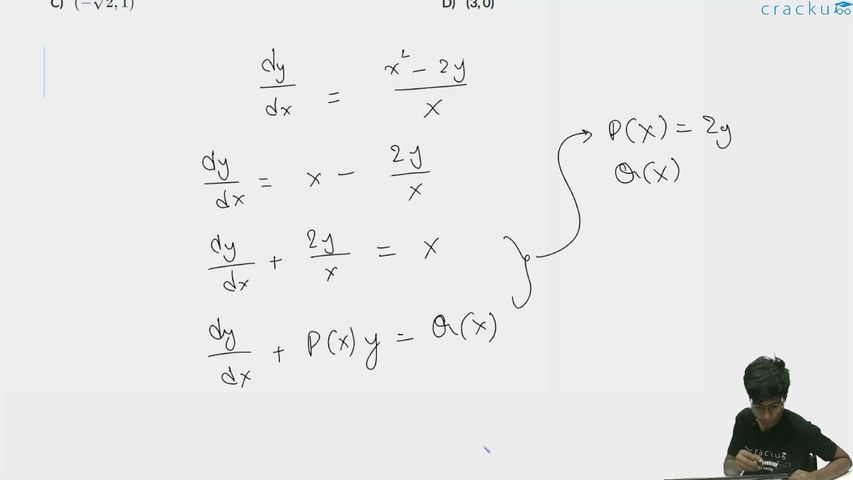
$$\frac{dy}{dx}=\frac{x^{2}-2y}{x}.$$
We separate the terms involving $$y$$ to the left and the terms involving $$x$$ to the right by first writing
$$\frac{dy}{dx}=x-\frac{2y}{x}.$$
Now we bring the $$y$$-term to the left:
$$\frac{dy}{dx}+\frac{2}{x}\,y = x.$$
This is a first-order linear differential equation of the standard form
$$\frac{dy}{dx}+P(x)\,y = Q(x),$$
with $$P(x)=\dfrac{2}{x}$$ and $$Q(x)=x.$$
The integrating factor (I.F.) for such an equation is obtained from the formula
$$\text{I.F.}=e^{\int P(x)\,dx}.$$
Calculating the integral, we get
$$\int P(x)\,dx=\int\frac{2}{x}\,dx = 2\ln x,$$
so
$$\text{I.F.}=e^{2\ln x}=x^{2}.$$
Multiplying every term of the differential equation by this integrating factor, we have
$$x^{2}\frac{dy}{dx}+2x\,y = x^{3}.$$
Notice that the left-hand side is precisely the derivative of the product $$x^{2}y$$ because
$$\frac{d}{dx}\left(x^{2}y\right)=x^{2}\frac{dy}{dx}+2x\,y.$$
Therefore we may rewrite the equation in the compact form
$$\frac{d}{dx}\!\left(x^{2}y\right)=x^{3}.$$
We integrate both sides with respect to $$x$$:
$$\int\frac{d}{dx}\!\left(x^{2}y\right)\,dx = \int x^{3}\,dx.$$
On integration we obtain
$$x^{2}y=\frac{x^{4}}{4}+C,$$
where $$C$$ is the constant of integration. Solving for $$y$$ gives
$$y=\frac{x^{2}}{4}+\frac{C}{x^{2}}.$$
We now use the information that the curve passes through the known point $$\,(1,-2)\,.$$ Substituting $$x=1$$ and $$y=-2$$:
$$-2 = \frac{1}{4}+\frac{C}{1} = \frac{1}{4} + C.$$
So
$$C = -2 - \frac{1}{4} = -\frac{9}{4}.$$
Consequently, the equation of the required curve is
$$y = \frac{x^{2}}{4} - \frac{9}{4x^{2}}.$$
To decide which option also lies on this curve, we substitute the coordinates of each choice into this equation.
Option A: $$(x,y)=(\sqrt{3},\,0).$$ Substituting, we get
$$y = 0 \quad\text{and}\quad \frac{(\sqrt{3})^{2}}{4}-\frac{9}{4(\sqrt{3})^{2}} = \frac{3}{4}-\frac{9}{12} = \frac{3}{4}-\frac{3}{4}=0.$$
The left-hand side equals the right-hand side, so $$(\sqrt{3},0)$$ lies on the curve.
Option B: $$(x,y)=(-1,\,2).$$ Using the formula,
$$y=\frac{(-1)^{2}}{4}-\frac{9}{4(-1)^{2}}=\frac{1}{4}-\frac{9}{4}=-2\neq 2.$$
This point is not on the curve.
Option C: $$(x,y)=(-\sqrt{2},\,1).$$ We find
$$y=\frac{(\sqrt{2})^{2}}{4}-\frac{9}{4(\sqrt{2})^{2}} =\frac{2}{4}-\frac{9}{8} =\frac{1}{2}-\frac{9}{8}=-\frac{5}{8}\neq 1.$$
This point is not on the curve.
Option D: $$(x,y)=(3,\,0).$$ We obtain
$$y=\frac{3^{2}}{4}-\frac{9}{4(3)^{2}}=\frac{9}{4}-\frac{1}{4}=2\neq 0.$$
This point is not on the curve either.
Hence only Option A satisfies the equation of the curve derived from the given conditions.
Hence, the correct answer is Option A.
Was this solution helpful?
Click on the Email ☝️ to Watch the Video Solution
Create a FREE account and get:
_1.webp)

Educational materials for JEE preparation

Ask our AI anything

AI can make mistakes. Please verify important information.
AI can make mistakes. Please verify important information.


