
Join Our JEE Preparation Group
Prep with like-minded aspirants; Get access to free daily tests and study material.
Sign in
Please select an account to continue using cracku.in
↓ →
Join Our JEE Preparation Group
Prep with like-minded aspirants; Get access to free daily tests and study material.
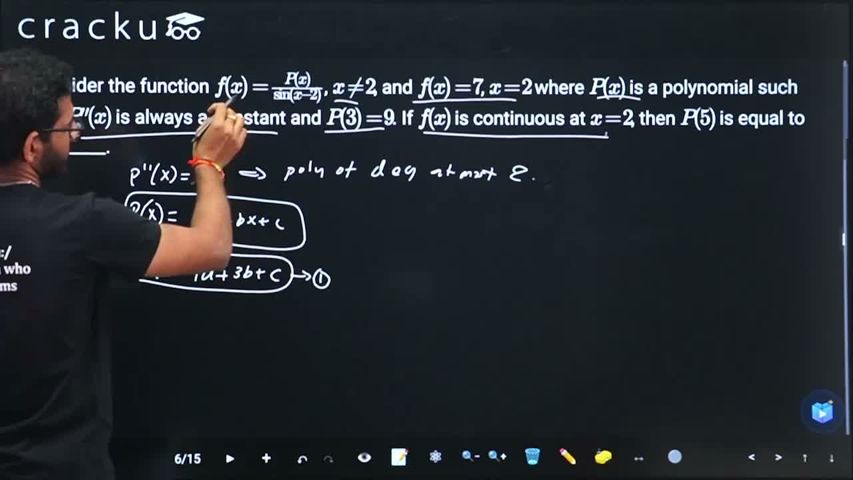
Consider the function $$f(x) = \frac{P(x)}{\sin(x - 2)}$$, $$x \neq 2$$, and $$f(x) = 7$$, $$x = 2$$ where $$P(x)$$ is a polynomial such that $$P''(x)$$ is always a constant and $$P(3) = 9$$. If $$f(x)$$ is continuous at $$x = 2$$, then $$P(5)$$ is equal to _________.
Correct Answer: 39
We have the function defined as $$f(x)=\dfrac{P(x)}{\sin\,(x-2)} \quad\text{for }x\neq 2$$ and $$f(2)=7.$$
Because the question states that $$f(x)$$ is continuous at $$x=2$$, the limit of the first formula as $$x\to 2$$ must equal the explicitly given value at that point. Hence we require
$$\lim_{x\to 2}\dfrac{P(x)}{\sin\,(x-2)} \;=\;7.$$
Next we use the standard limit fact $$\displaystyle\lim_{u\to 0}\frac{\sin u}{u}=1,$$ which can be rewritten (by taking reciprocals) as $$\displaystyle\lim_{u\to 0}\frac{u}{\sin u}=1.$$ Writing $$u = x-2,$$ we see that $$u\to 0$$ exactly when $$x\to 2.$$ Therefore near $$x=2$$ we may replace $$\sin (x-2)$$ by $$(x-2)$$ inside limits. It follows that, to keep the fraction finite, the numerator must also vanish at $$x=2.$$ So we must have
$$P(2)=0.$$
With $$P(2)=0$$ established, both numerator and denominator approach $$0$$ in the limit, so L’Hospital’s Rule may be applied. L’Hospital’s Rule states that if $$\displaystyle\lim_{x\to a} \dfrac{g(x)}{h(x)}$$ is an indeterminate form $$0/0,$$ then
$$\lim_{x\to a}\dfrac{g(x)}{h(x)}=\lim_{x\to a}\dfrac{g'(x)}{h'(x)},$$
provided the latter limit exists. Using $$g(x)=P(x)$$ and $$h(x)=\sin(x-2),$$ we obtain
$$\lim_{x\to 2}\dfrac{P(x)}{\sin (x-2)}=\lim_{x\to 2}\dfrac{P'(x)}{\cos (x-2)}.$$
Since $$\cos(0)=1,$$ the right-hand limit simplifies to $$P'(2).$$ Continuity therefore forces
$$P'(2)=7.$$
The problem also states that $$P''(x)$$ is a constant for all $$x.$$ A constant second derivative implies that $$P(x)$$ must be a quadratic polynomial. Let us write
$$P''(x)=k,\qquad k\text{ constant}.$$
Integrating once,
$$P'(x)=kx+d,$$
where $$d$$ is a constant of integration. Substituting $$x=2$$ and using $$P'(2)=7$$ gives
$$k\cdot 2+d=7\quad\Longrightarrow\quad 2k+d=7. \quad -(1)$$
Integrating $$P'(x)$$ again yields
$$P(x)=\frac{k}{2}x^{2}+dx+e,$$
with a second integration constant $$e.$$ Using the already-proved fact $$P(2)=0$$ we substitute $$x=2$$ to get
$$\frac{k}{2}\,(2)^{2}+d\,(2)+e=0 \;\Longrightarrow\; 2k+2d+e=0. \quad -(2)$$
We are additionally told that $$P(3)=9.$$ Substituting $$x=3$$ gives
$$\frac{k}{2}\,(3)^{2}+d\,(3)+e=9 \;\Longrightarrow\; \frac{9k}{2}+3d+e=9. \quad -(3)$$
Now we solve the simultaneous linear equations (1), (2) and (3).
From (1) we can express $$d$$ directly:
$$d=7-2k.$$
Substituting this value of $$d$$ into (2) gives
$$2k+2(7-2k)+e=0 \;\Longrightarrow\; 2k+14-4k+e=0 \;\Longrightarrow\; -2k+14+e=0 \;\Longrightarrow\; e=2k-14.$$
Next we insert both $$d=7-2k$$ and $$e=2k-14$$ into equation (3):
$$\frac{9k}{2}+3(7-2k)+(2k-14)=9.$$
Performing the algebra step by step,
$$\frac{9k}{2}+21-6k+2k-14=9,$$
which simplifies to
$$\frac{9k}{2}-4k+7=9.$$
Combining the $$k$$ terms by writing $$-4k=-\dfrac{8k}{2},$$ we get
$$\frac{9k}{2}-\frac{8k}{2}+7=9 \;\Longrightarrow\; \frac{k}{2}+7=9 \;\Longrightarrow\; \frac{k}{2}=2 \;\Longrightarrow\; k=4.$$
With $$k=4,$$ we quickly find the remaining constants:
$$d=7-2k=7-8=-1,$$
$$e=2k-14=8-14=-6.$$
Therefore the explicit quadratic polynomial is
$$P(x)=\frac{4}{2}x^{2}-x-6=2x^{2}-x-6.$$
Finally we compute $$P(5):$$
$$P(5)=2(5)^{2}-5-6=2\cdot25-5-6=50-5-6=39.$$
So, the answer is $$39$$.
Was this solution helpful?
Click on the Email ☝️ to Watch the Video Solution
Create a FREE account and get:
_1.webp)

Educational materials for JEE preparation

Ask our AI anything

AI can make mistakes. Please verify important information.
AI can make mistakes. Please verify important information.
