
Join Our JEE Preparation Group
Prep with like-minded aspirants; Get access to free daily tests and study material.
Sign in
Please select an account to continue using cracku.in
↓ →
Join Our JEE Preparation Group
Prep with like-minded aspirants; Get access to free daily tests and study material.
If the co-efficient of $$x^7$$ and $$x^8$$ in the expansion of $$\left(2 + \frac{x}{3}\right)^n$$ are equal, then the value of $$n$$ is equal to:
Correct Answer: 55
We consider the binomial expansion formula first. For any real numbers $$a$$ and $$b$$ and a positive integer $$n$$, the expansion of $$(a+b)^n$$ is written as
$$ (a+b)^n = \sum_{r=0}^{n} \binom{n}{r}\,a^{\,n-r}\,b^{\,r}. $$
Here, the general term (also called the $$(r+1)^\text{th}$$ term) is
$$ T_{r+1} = \binom{n}{r}\,a^{\,n-r}\,b^{\,r}. $$
Now, in our problem we have $$a = 2$$ and $$b = \dfrac{x}{3}$$, so the expansion of $$\left(2+\dfrac{x}{3}\right)^n$$ is
$$ \left(2+\dfrac{x}{3}\right)^n = \sum_{r=0}^{n} \binom{n}{r}\,2^{\,n-r}\left(\dfrac{x}{3}\right)^{r}. $$
From this, the coefficient of the term containing $$x^{r}$$ is obtained by looking at the power of $$x$$ in each term. Since $$\left(\dfrac{x}{3}\right)^r = \dfrac{x^{r}}{3^{\,r}},$$ the coefficient of $$x^{r}$$ is
$$ \binom{n}{r}\,2^{\,n-r}\,\dfrac{1}{3^{\,r}}. $$
We are told that the coefficients of $$x^{7}$$ and $$x^{8}$$ are equal. Writing these coefficients explicitly:
Coefficient of $$x^{7}$$
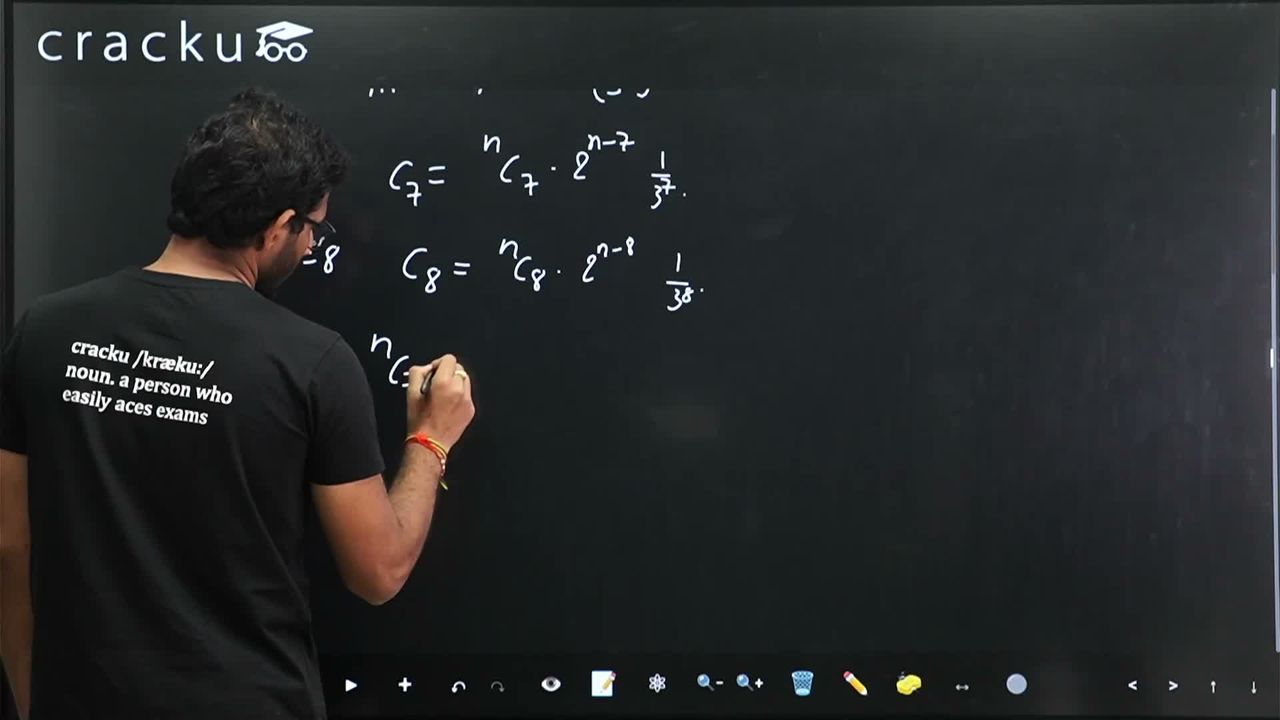
$$ C_7 = \binom{n}{7}\,2^{\,n-7}\,\dfrac{1}{3^{\,7}}. $$
Coefficient of $$x^{8}$$
$$ C_8 = \binom{n}{8}\,2^{\,n-8}\,\dfrac{1}{3^{\,8}}. $$
The condition given in the problem is
$$ C_7 = C_8. $$
Substituting the explicit expressions, we have
$$ \binom{n}{7}\,2^{\,n-7}\,\dfrac{1}{3^{\,7}} \;=\; \binom{n}{8}\,2^{\,n-8}\,\dfrac{1}{3^{\,8}}. $$
We start simplifying this equality step by step. First, divide both sides by the common positive factor $$2^{\,n-8}\,\dfrac{1}{3^{\,7}}$$ (which is definitely non-zero):
$$ \binom{n}{7}\;2^{\,n-7}\;\dfrac{1}{3^{\,7}} \;\Bigg/\; \Bigl(2^{\,n-8}\,\dfrac{1}{3^{\,7}}\Bigr) \;=\; \binom{n}{8}\;2^{\,n-8}\;\dfrac{1}{3^{\,8}} \;\Bigg/\; \Bigl(2^{\,n-8}\,\dfrac{1}{3^{\,7}}\Bigr). $$
Simplifying the left‐hand side first:
$$ \frac{2^{\,n-7}}{2^{\,n-8}} = 2^{\,1} = 2, \qquad \frac{1/3^{\,7}}{1/3^{\,7}} = 1. $$
So the left‐hand side simplifies to
$$ 2\,\binom{n}{7}. $$
Simplifying the right‐hand side likewise, observe
$$ \frac{1/3^{\,8}}{1/3^{\,7}} = \frac{1}{3}, \qquad \frac{2^{\,n-8}}{2^{\,n-8}} = 1, $$
so the right‐hand side becomes
$$ \frac{1}{3}\,\binom{n}{8}. $$
Equating these simplified expressions gives
$$ 2\,\binom{n}{7} \;=\; \frac{1}{3}\,\binom{n}{8}. $$
Multiplying both sides by $$3$$ to clear the denominator, we get
$$ 6\,\binom{n}{7} = \binom{n}{8}. $$
Next, we use the well-known relation between consecutive binomial coefficients, namely
$$ \frac{\binom{n}{7}}{\binom{n}{8}} = \frac{8}{n-7}. $$
This formula itself comes from expanding the factorial form:
$$ \frac{\binom{n}{7}}{\binom{n}{8}} = \frac{\displaystyle\frac{n!}{7!\,(n-7)!}} {\displaystyle\frac{n!}{8!\,(n-8)!}} = \frac{8!\,(n-8)!}{7!\,(n-7)!} = \frac{8}{n-7}. $$
Returning to our equation $$6\,\binom{n}{7} = \binom{n}{8},$$ divide both sides by $$\binom{n}{8}$$ (which is certainly non-zero for $$n \ge 8$$):
$$ 6\,\frac{\binom{n}{7}}{\binom{n}{8}} = 1. $$
Substituting the ratio $$\dfrac{\binom{n}{7}}{\binom{n}{8}} = \dfrac{8}{n-7}$$ gives
$$ 6 \times \frac{8}{n-7} = 1. $$
Hence
$$ \frac{48}{n-7} = 1. $$
Now multiply both sides by $$n-7$$ and obtain
$$ 48 = n-7. $$
Finally, adding $$7$$ to both sides yields
$$ n = 55. $$
So, the answer is $$55$$.
Was this solution helpful?
Click on the Email ☝️ to Watch the Video Solution
Create a FREE account and get:
_1.webp)

Educational materials for JEE preparation

Ask our AI anything

AI can make mistakes. Please verify important information.
AI can make mistakes. Please verify important information.
