
Join Our JEE Preparation Group
Prep with like-minded aspirants; Get access to free daily tests and study material.
Sign in
Please select an account to continue using cracku.in
↓ →
Join Our JEE Preparation Group
Prep with like-minded aspirants; Get access to free daily tests and study material.
Let $${}^nC_r$$ denote the binomial coefficient of $$x^r$$ in the expansion of $$(1+x)^n$$. If $$\sum_{k=0}^{10} (2^2 + 3k) {}^{10}C_k = \alpha \cdot 3^{10} + \beta \cdot 2^{10}$$, $$\alpha, \beta \in R$$, then $$\alpha + \beta$$ is equal to ___.
Correct Answer: 19
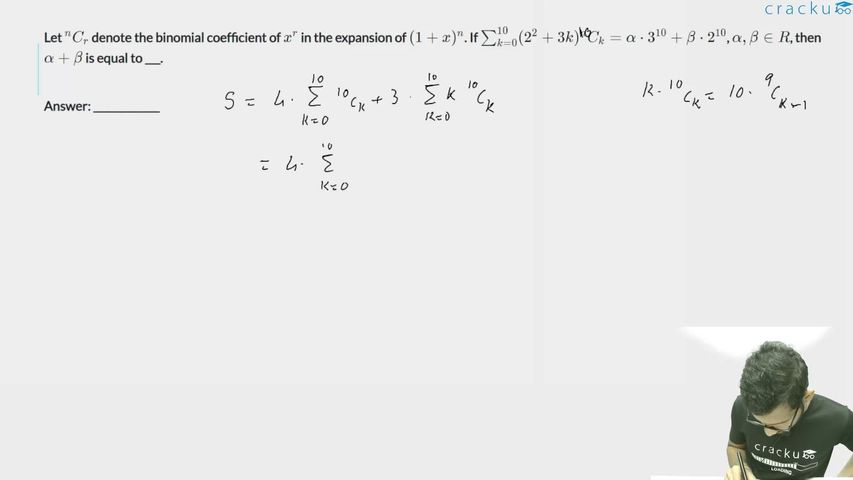
We evaluate $$S = \sum_{k=0}^{10}(4 + 3k)\binom{10}{k}$$ by splitting it into two sums: $$S = 4\sum_{k=0}^{10}\binom{10}{k} + 3\sum_{k=0}^{10}k\binom{10}{k}$$.
Using standard identities: $$\sum_{k=0}^{10}\binom{10}{k} = 2^{10}$$ and $$\sum_{k=0}^{10}k\binom{10}{k} = 10 \cdot 2^{9}$$ (since $$k\binom{10}{k} = 10\binom{9}{k-1}$$). Substituting: $$S = 4 \cdot 2^{10} + 3 \cdot 10 \cdot 2^9 = 4 \cdot 1024 + 30 \cdot 512 = 4096 + 15360 = 19456$$.
We need $$19456 = \alpha \cdot 3^{10} + \beta \cdot 2^{10}$$, i.e., $$19456 = 59049\alpha + 1024\beta$$. Since $$19456 = 19 \cdot 1024 = 19 \cdot 2^{10}$$, we can take $$\alpha = 0$$ and $$\beta = 19$$. Therefore $$\alpha + \beta = 0 + 19 = 19$$.
Was this solution helpful?
Click on the Email ☝️ to Watch the Video Solution
Create a FREE account and get:
_1.webp)

Educational materials for JEE preparation

Ask our AI anything

AI can make mistakes. Please verify important information.
AI can make mistakes. Please verify important information.
