
Join Our JEE Preparation Group
Prep with like-minded aspirants; Get access to free daily tests and study material.
Sign in
Please select an account to continue using cracku.in
↓ →
Join Our JEE Preparation Group
Prep with like-minded aspirants; Get access to free daily tests and study material.
If $$\lim_{x \to 0} \frac{ae^x - b\cos x + ce^{-x}}{x \sin x} = 2$$, then $$a + b + c$$ is equal to ________.
Correct Answer: 4
We need to find $$\lim_{x \to 0} \frac{ae^x - b\cos x + ce^{-x}}{x \sin x} = 2$$.
As $$x \to 0$$, the denominator $$x\sin x \to 0$$. For the limit to exist and be finite, the numerator must also vanish at $$x = 0$$. Substituting $$x = 0$$ in the numerator: $$a \cdot 1 - b \cdot 1 + c \cdot 1 = a - b + c = 0$$. This gives us our first condition: $$a - b + c = 0$$ ... (i).
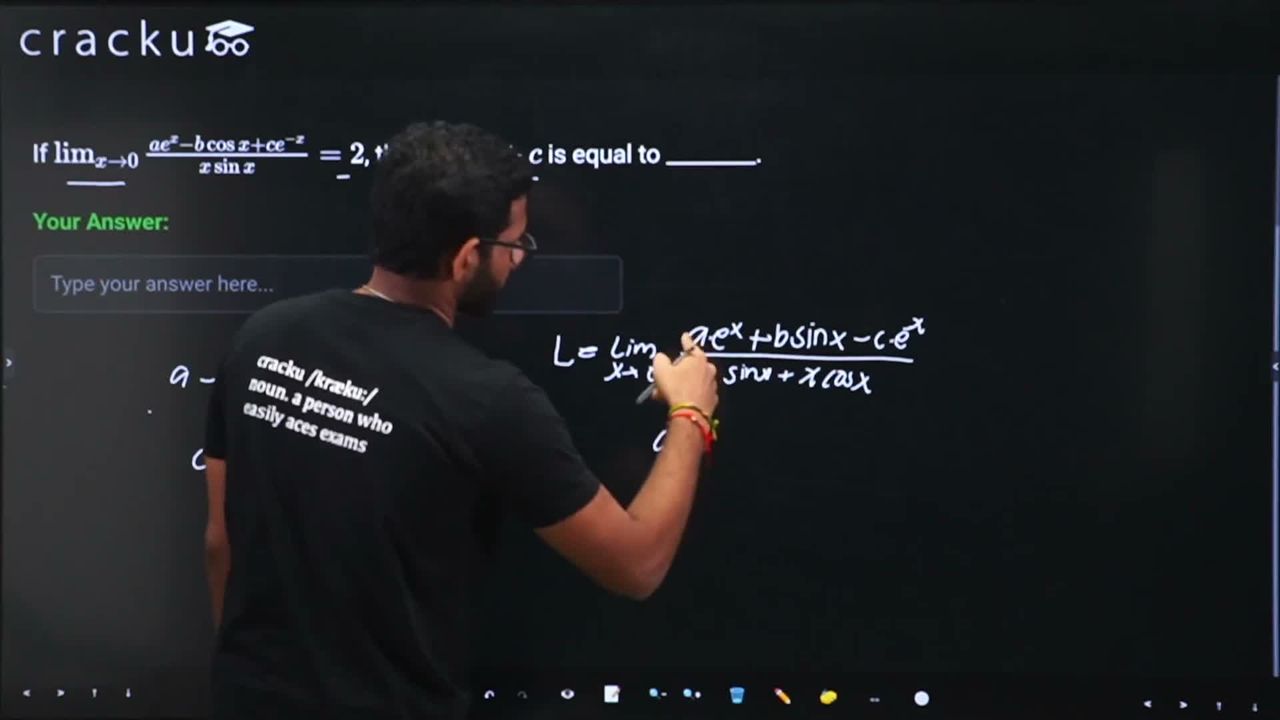
Since we have a $$\frac{0}{0}$$ form, we apply L'Hopital's rule. Differentiating the numerator gives $$ae^x + b\sin x - ce^{-x}$$, and differentiating the denominator gives $$\sin x + x\cos x$$. Evaluating at $$x = 0$$: the numerator becomes $$a \cdot 1 + b \cdot 0 - c \cdot 1 = a - c$$, and the denominator becomes $$0 + 0 = 0$$. For the limit to still exist as a finite value, we again need the numerator to vanish: $$a - c = 0$$ ... (ii).
We still have a $$\frac{0}{0}$$ form, so we apply L'Hopital's rule a second time. Differentiating the numerator again gives $$ae^x + b\cos x + ce^{-x}$$, and differentiating the denominator again gives $$\cos x + \cos x - x\sin x = 2\cos x - x\sin x$$. Evaluating at $$x = 0$$: the numerator becomes $$a + b + c$$, and the denominator becomes $$2$$. Therefore the limit equals $$\frac{a + b + c}{2} = 2$$, which gives $$a + b + c = 4$$ ... (iii).
From equation (i): $$b = a + c$$. From equation (ii): $$a = c$$. Substituting $$a = c$$ into $$b = a + c$$: $$b = 2a$$. Now substituting into equation (iii): $$a + 2a + a = 4$$, so $$4a = 4$$, which gives $$a = 1$$. Therefore $$c = 1$$ and $$b = 2$$.
Hence $$a + b + c = 1 + 2 + 1 = 4$$.
Click on the Email ☝️ to Watch the Video Solution
Create a FREE account and get:
_1.webp)

Educational materials for JEE preparation

Ask our AI anything

AI can make mistakes. Please verify important information.
AI can make mistakes. Please verify important information.


