
Join Our JEE Preparation Group
Prep with like-minded aspirants; Get access to free daily tests and study material.
Sign in
Please select an account to continue using cracku.in
↓ →
Join Our JEE Preparation Group
Prep with like-minded aspirants; Get access to free daily tests and study material.
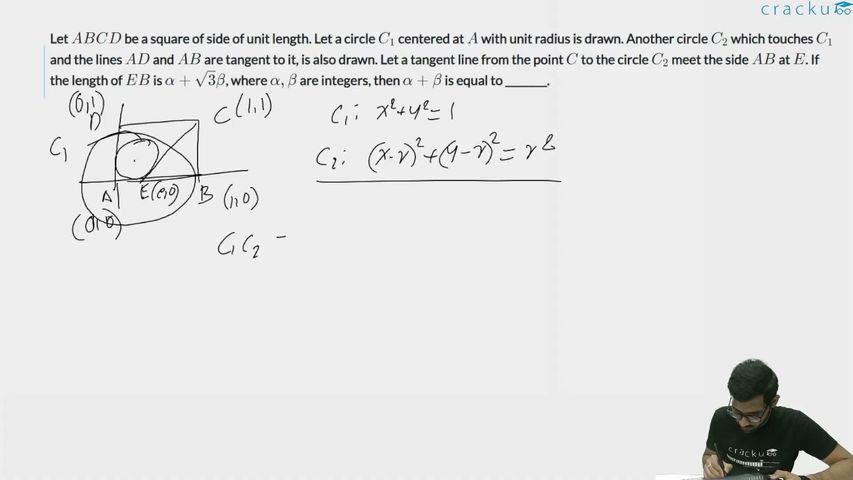
Let $$ABCD$$ be a square of side of unit length. Let a circle $$C_1$$ centered at $$A$$ with unit radius is drawn. Another circle $$C_2$$ which touches $$C_1$$ and the lines $$AD$$ and $$AB$$ are tangent to it, is also drawn. Let a tangent line from the point $$C$$ to the circle $$C_2$$ meet the side $$AB$$ at $$E$$. If the length of $$EB$$ is $$\alpha + \sqrt{3}\beta$$, where $$\alpha, \beta$$ are integers, then $$\alpha + \beta$$ is equal to ________.
Correct Answer: 1
Let the square $$ABCD$$ have vertices $$A = (0, 0)$$, $$B = (1, 0)$$, $$C = (1, 1)$$, $$D = (0, 1)$$. Circle $$C_1$$ is centered at $$A = (0,0)$$ with radius 1.
Circle $$C_2$$ touches lines $$AB$$ (the $$x$$-axis) and $$AD$$ (the $$y$$-axis), so its center is at $$(r, r)$$ for some radius $$r > 0$$. Since $$C_2$$ touches $$C_1$$ internally ($$C_2$$ is inside the region bounded by $$C_1$$), the distance between centers equals $$1 - r$$: $$r\sqrt{2} = 1 - r$$, giving $$r(\sqrt{2} + 1) = 1$$, so $$r = \frac{1}{\sqrt{2} + 1} = \sqrt{2} - 1$$.
So $$C_2$$ has center $$(\sqrt{2} - 1, \sqrt{2} - 1)$$ and radius $$r = \sqrt{2} - 1$$.
A tangent from $$C = (1, 1)$$ to circle $$C_2$$ meets $$AB$$ (the segment from $$(0,0)$$ to $$(1,0)$$, i.e., the $$x$$-axis with $$0 \leq x \leq 1$$) at point $$E$$. The tangent line passes through $$C = (1,1)$$ and touches $$C_2$$. Let $$E = (e, 0)$$ on $$AB$$.
The line through $$(1, 1)$$ and $$(e, 0)$$ has equation: $$y - 0 = \frac{1 - 0}{1 - e}(x - e)$$, i.e., $$x - (1-e)y - e = 0$$.
The distance from center $$(\sqrt{2}-1, \sqrt{2}-1)$$ to this line equals $$r = \sqrt{2} - 1$$:
$$\frac{|(\sqrt{2}-1) - (1-e)(\sqrt{2}-1) - e|}{\sqrt{1 + (1-e)^2}} = \sqrt{2} - 1$$.
The numerator simplifies: $$(\sqrt{2}-1)[1 - (1-e)] - e = (\sqrt{2}-1)e - e = e(\sqrt{2} - 2)$$. Taking absolute value: $$e(2 - \sqrt{2})$$.
So $$\frac{e(2 - \sqrt{2})}{\sqrt{1 + (1-e)^2}} = \sqrt{2} - 1$$.
Squaring both sides: $$\frac{e^2(2 - \sqrt{2})^2}{1 + (1-e)^2} = (\sqrt{2} - 1)^2 = 3 - 2\sqrt{2}$$.
Note $$(2 - \sqrt{2})^2 = 6 - 4\sqrt{2} = 2(3 - 2\sqrt{2})$$. So $$\frac{2e^2(3 - 2\sqrt{2})}{1 + (1-e)^2} = 3 - 2\sqrt{2}$$, giving $$\frac{2e^2}{1 + (1-e)^2} = 1$$.
Therefore $$2e^2 = 1 + 1 - 2e + e^2 = 2 - 2e + e^2$$, so $$e^2 + 2e - 2 = 0$$. Using the quadratic formula: $$e = \frac{-2 + \sqrt{4 + 8}}{2} = \frac{-2 + 2\sqrt{3}}{2} = -1 + \sqrt{3}$$.
Then $$EB = 1 - e = 1 - (-1 + \sqrt{3}) = 2 - \sqrt{3}$$. So $$\alpha + \sqrt{3}\beta = 2 - \sqrt{3}$$, giving $$\alpha = 2$$ and $$\beta = -1$$.
Therefore $$\alpha + \beta = 2 + (-1) = 1$$.
Click on the Email ☝️ to Watch the Video Solution
Create a FREE account and get:
_1.webp)

Educational materials for JEE preparation

Ask our AI anything

AI can make mistakes. Please verify important information.
AI can make mistakes. Please verify important information.


