
Join Our JEE Preparation Group
Prep with like-minded aspirants; Get access to free daily tests and study material.
Sign in
Please select an account to continue using cracku.in
↓ →
Join Our JEE Preparation Group
Prep with like-minded aspirants; Get access to free daily tests and study material.
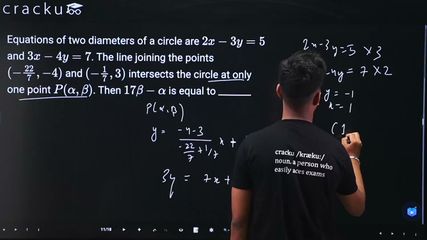
Equations of two diameters of a circle are $$2x - 3y = 5$$ and $$3x - 4y = 7$$. The line joining the points $$(-\frac{22}{7}, -4)$$ and $$(-\frac{1}{7}, 3)$$ intersects the circle at only one point $$P(\alpha, \beta)$$. Then $$17\beta - \alpha$$ is equal to _______
Correct Answer: 2
We have two diameters of a circle: $$2x - 3y = 5$$ and $$3x - 4y = 7$$.
Find the center of the circle (intersection of diameters).
From $$2x - 3y = 5$$ and $$3x - 4y = 7$$:
Multiply first by 4: $$8x - 12y = 20$$
Multiply second by 3: $$9x - 12y = 21$$
Subtracting: $$x = 1$$, then $$2(1) - 3y = 5 \implies y = -1$$.
Center: $$(1, -1)$$.
Find the equation of the line joining $$\left(-\frac{22}{7}, -4\right)$$ and $$\left(-\frac{1}{7}, 3\right)$$.
Slope: $$\frac{3 - (-4)}{-\frac{1}{7} - (-\frac{22}{7})} = \frac{7}{\frac{21}{7}} = \frac{7}{3}$$
Line equation: $$y - 3 = \frac{7}{3}\left(x + \frac{1}{7}\right) \implies y = \frac{7x}{3} + \frac{1}{3} + 3 = \frac{7x + 10}{3}$$
Or: $$7x - 3y + 10 = 0$$
Since the line intersects the circle at only one point, it is tangent to the circle. The point $$P(\alpha, \beta)$$ is the foot of perpendicular from the center to the line.
$$\alpha = 1 - \frac{7(7 \cdot 1 - 3(-1) + 10)}{49 + 9} = 1 - \frac{7 \times 20}{58} = 1 - \frac{140}{58} = 1 - \frac{70}{29} = -\frac{41}{29}$$
$$\beta = -1 + \frac{3(7 \cdot 1 - 3(-1) + 10)}{58} = -1 + \frac{3 \times 20}{58} = -1 + \frac{60}{58} = -1 + \frac{30}{29} = \frac{1}{29}$$
Compute $$17\beta - \alpha$$.
$$17\beta - \alpha = \frac{17}{29} - \left(-\frac{41}{29}\right) = \frac{17 + 41}{29} = \frac{58}{29} = 2$$
The answer is $$\boxed{2}$$.
Was this solution helpful?
Click on the Email ☝️ to Watch the Video Solution
Create a FREE account and get:
_1.webp)

Educational materials for JEE preparation

Ask our AI anything

AI can make mistakes. Please verify important information.
AI can make mistakes. Please verify important information.
