
Join Our JEE Preparation Group
Prep with like-minded aspirants; Get access to free daily tests and study material.
Sign in
Please select an account to continue using cracku.in
↓ →
Join Our JEE Preparation Group
Prep with like-minded aspirants; Get access to free daily tests and study material.
Let $$a_1 = b_1 = 1$$, $$a_n = a_{n-1} + 2$$ and $$b_n = a_n + b_{n-1}$$ for every natural number $$n \ge 2$$. Then $$\displaystyle\sum_{n=1}^{15} a_n \cdot b_n$$ is equal to ______.
Correct Answer: 27560
We are given $$a_1 = b_1 = 1$$, $$a_n = a_{n-1} + 2$$ for $$n \ge 2$$, and $$b_n = a_n + b_{n-1}$$ for $$n \ge 2$$. We need to find $$\displaystyle\sum_{n=1}^{15} a_n \cdot b_n$$.
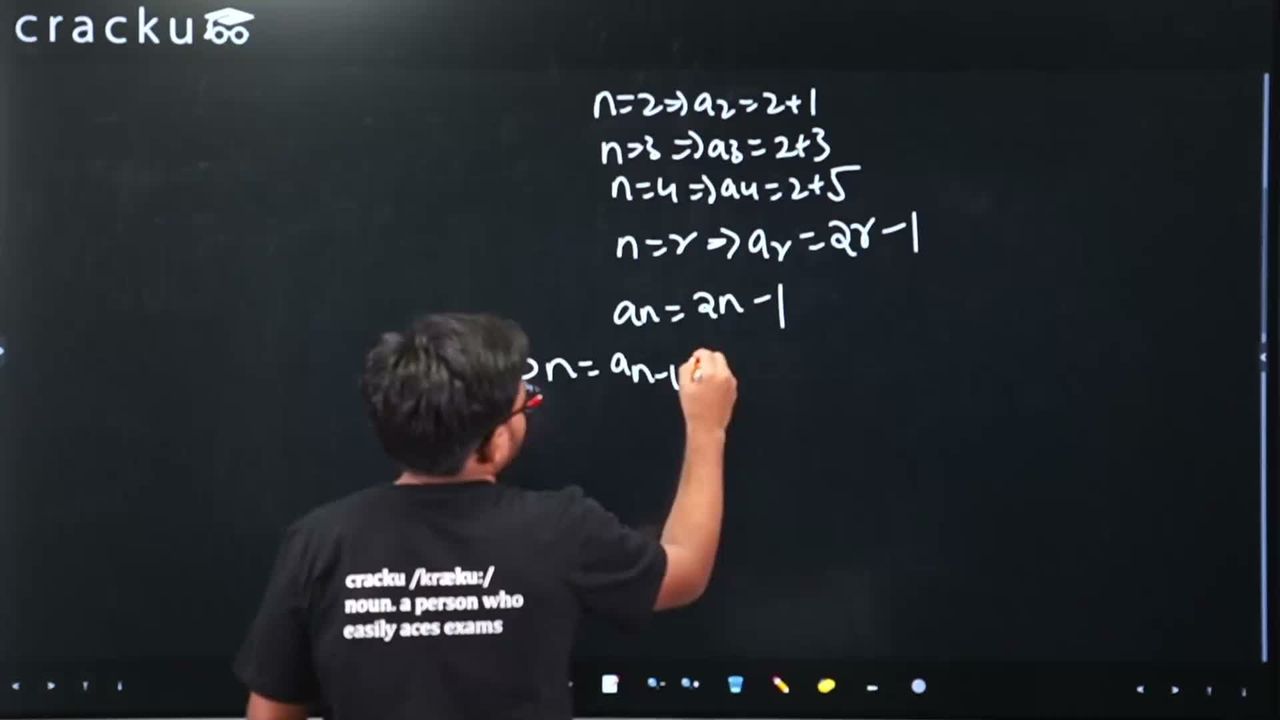
Since $$a_n = a_1 + 2(n-1)$$ and $$a_1 = 1$$, we obtain $$a_n = 1 + 2(n-1) = 2n - 1$$, which enumerates the odd numbers 1, 3, 5, 7, ….
Next, applying the recursion $$b_n = a_n + b_{n-1}$$ with $$b_1 = 1$$ gives
$$b_n = b_1 + \sum_{k=2}^{n} a_k = 1 + \sum_{k=2}^{n}(2k-1) = 1 + \left(\sum_{k=1}^{n}(2k-1)\right) - 1 = \sum_{k=1}^{n}(2k-1) = n^2$$
A quick verification shows that $$b_1 = 1 = 1^2$$, $$b_2 = a_2 + b_1 = 3 + 1 = 4 = 2^2$$, and $$b_3 = 5 + 4 = 9 = 3^2$$, confirming the pattern.
Hence, $$b_n = n^2$$.
We now compute the required sum as $$\sum_{n=1}^{15} a_n b_n = \sum_{n=1}^{15} (2n-1)n^2$$, which can be separated into
$$\sum_{n=1}^{15} (2n-1)n^2 = \sum_{n=1}^{15} (2n^3 - n^2)$$
$$= 2\sum_{n=1}^{15} n^3 - \sum_{n=1}^{15} n^2$$
For the sum of cubes, the standard formula gives $$\sum_{n=1}^{15} n^3 = \left(\dfrac{15 \cdot 16}{2}\right)^2 = 120^2 = 14400$$.
For the sum of squares, the formula yields $$\sum_{n=1}^{15} n^2 = \dfrac{15 \cdot 16 \cdot 31}{6} = \dfrac{7440}{6} = 1240$$.
Substituting these values into the expression gives
$$2(14400) - 1240 = 28800 - 1240 = 27560$$
Consequently, the required sum is $$27560$$.
Was this solution helpful?
Click on the Email ☝️ to Watch the Video Solution
Create a FREE account and get:
_1.webp)

Educational materials for JEE preparation

Ask our AI anything

AI can make mistakes. Please verify important information.
AI can make mistakes. Please verify important information.
