
Join Our JEE Preparation Group
Prep with like-minded aspirants; Get access to free daily tests and study material.
Sign in
Please select an account to continue using cracku.in
↓ →
Join Our JEE Preparation Group
Prep with like-minded aspirants; Get access to free daily tests and study material.
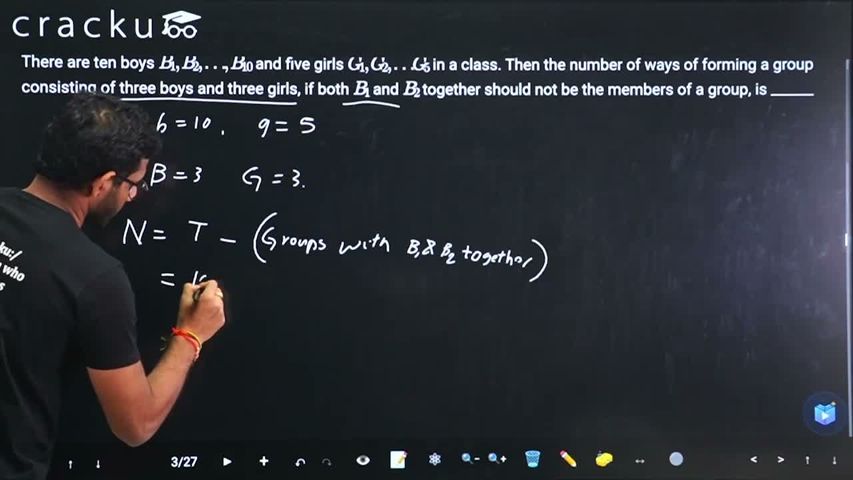
There are ten boys $$B_1, B_2, \ldots, B_{10}$$ and five girls $$G_1, G_2, \ldots G_5$$ in a class. Then the number of ways of forming a group consisting of three boys and three girls, if both $$B_1$$ and $$B_2$$ together should not be the members of a group, is ______
Correct Answer: 1120
Ten boys $$B_1, B_2, \ldots, B_{10}$$ and five girls $$G_1, G_2, \ldots, G_5$$. We need groups of 3 boys and 3 girls where $$B_1$$ and $$B_2$$ are NOT both in the group.
Without any restriction, the total number of ways to select 3 boys from 10 and 3 girls from 5 is $$\binom{10}{3} \times \binom{5}{3} = 120 \times 10 = 1200$$.
However, we must subtract the cases in which both $$B_1$$ and $$B_2$$ are chosen. In such situations, we have already selected two boys, so the remaining boy must be chosen from the other 8 boys, and the girls are still chosen from all 5, giving $$\binom{8}{1} \times \binom{5}{3} = 8 \times 10 = 80$$.
Subtracting these restricted cases from the total yields $$1200 - 80 = 1120$$.
The answer is $$\boxed{1120}$$.
Was this solution helpful?
Click on the Email ☝️ to Watch the Video Solution
Create a FREE account and get:
_1.webp)

Educational materials for JEE preparation

Ask our AI anything

AI can make mistakes. Please verify important information.
AI can make mistakes. Please verify important information.
