
Join Our JEE Preparation Group
Prep with like-minded aspirants; Get access to free daily tests and study material.
Sign in
Please select an account to continue using cracku.in
↓ →
Join Our JEE Preparation Group
Prep with like-minded aspirants; Get access to free daily tests and study material.
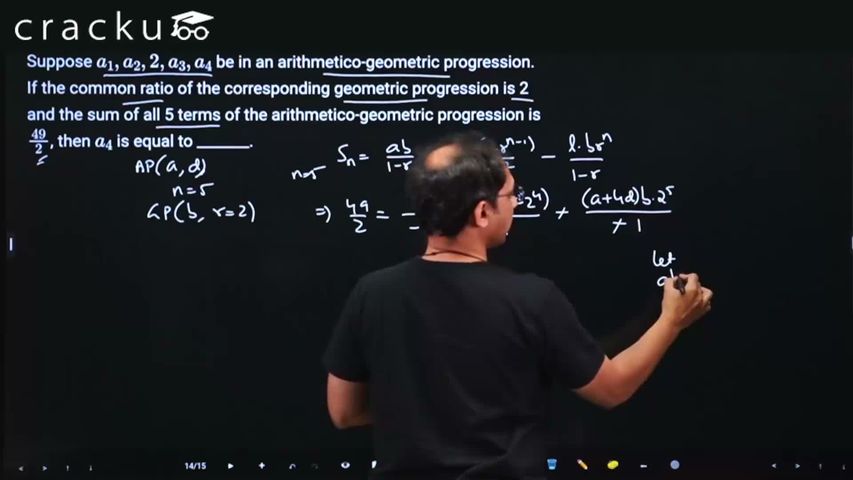
Suppose $$a_1, a_2, 2, a_3, a_4$$ be in an arithmetico-geometric progression. If the common ratio of the corresponding geometric progression is 2 and the sum of all 5 terms of the arithmetico-geometric progression is $$\frac{49}{2}$$, then $$a_4$$ is equal to _______.
Correct Answer: 16
An arithmetico-geometric progression (AGP) is obtained by multiplying each term of an arithmetic progression (AP) with the corresponding term of a geometric progression (GP).
Hence the $$n^{\text{th}}$$ term of an AGP can be written as
$$T_n = \bigl(b + (n-1)d\bigr)\,r^{\,n-1}$$
where
$$b$$ = first term of the AP, $$d$$ = common difference of the AP,
$$r$$ = common ratio of the GP.
In the question the five terms are
$$a_1,\,a_2,\,2,\,a_3,\,a_4$$
and the GP ratio is given as $$r = 2$$.
Therefore
$$T_n = \bigl(b + (n-1)d\bigr)\,2^{\,n-1}$$.
Term-wise equations
Term 1: $$a_1 = T_1 = b\cdot2^{0} = b$$
Term 2: $$a_2 = T_2 = (b + d)\,2^{1} = 2(b + d)$$
Term 3: $$2 = T_3 = (b + 2d)\,2^{2} = 4(b + 2d)$$
From the third term we get $$4(b + 2d) = 2 \;\Longrightarrow\; b + 2d = \frac12$$ $$-(1)$$
Sum of the first five terms
$$\begin{aligned} S_5 &= T_1 + T_2 + T_3 + T_4 + T_5\\ &= b + 2(b + d) + 4(b + 2d) + 8(b + 3d) + 16(b + 4d)\\ &= (1+2+4+8+16)\,b \;+\; (0+2+8+24+64)\,d\\ &= 31b + 98d \end{aligned}$$
The sum is given as $$\dfrac{49}{2}$$, hence $$31b + 98d = \frac{49}{2}$$ $$-(2)$$
Solving equations
From $$(1)$$: $$b = \frac12 - 2d$$. Substitute this in $$(2)$$:
$$\begin{aligned} 31\Bigl(\frac12 - 2d\Bigr) + 98d &= \frac{49}{2}\\[4pt] \frac{31}{2} - 62d + 98d &= \frac{49}{2}\\[4pt] 36d &= \frac{49 - 31}{2} = \frac{18}{2} = 9\\[4pt] d &= \frac{9}{36} = \frac14 \end{aligned}$$
Using $$d = \dfrac14$$ in $$(1)$$:
$$b = \frac12 - 2\Bigl(\frac14\Bigr) = \frac12 - \frac12 = 0$$.
Finding $$a_4$$
The fifth term (which is $$a_4$$) is $$T_5 = \bigl(b + 4d\bigr)\,2^{4} = \bigl(0 + 4\cdot\tfrac14\bigr)\,16 = (1)\,16 = 16.$$
Therefore, $$a_4 = 16$$.
Was this solution helpful?
Click on the Email ☝️ to Watch the Video Solution
Create a FREE account and get:
_1.webp)

Educational materials for JEE preparation

Ask our AI anything

AI can make mistakes. Please verify important information.
AI can make mistakes. Please verify important information.


