
Join Our JEE Preparation Group
Prep with like-minded aspirants; Get access to free daily tests and study material.
Sign in
Please select an account to continue using cracku.in
↓ →
Join Our JEE Preparation Group
Prep with like-minded aspirants; Get access to free daily tests and study material.
Let $$\alpha = 1^2 + 4^2 + 8^2 + 13^2 + 19^2 + 26^2 + \ldots$$ upto $$10$$ terms and $$\beta = \sum_{n=1}^{10} n^4$$. If $$4\alpha - \beta = 55k + 40$$, then $$k$$ is equal to _______.
Correct Answer: 353
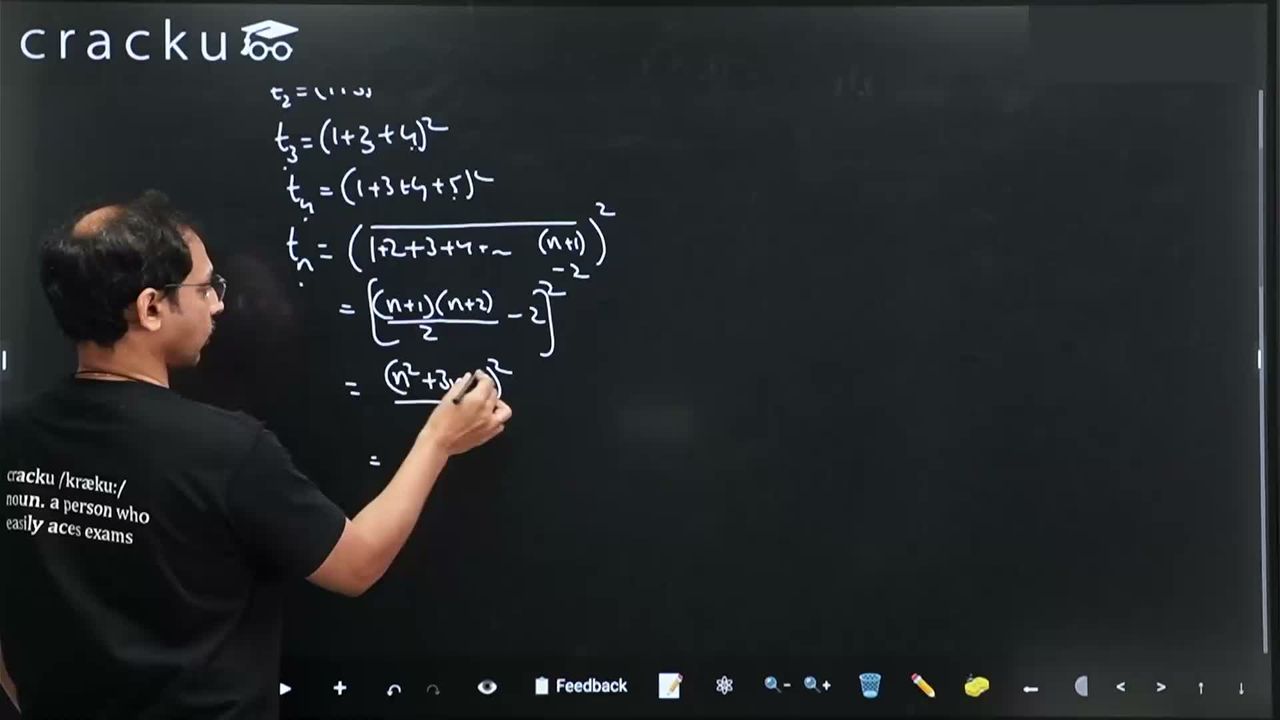
Let the terms inside the squares for $$\alpha$$ be $$t_n$$. The sequence is $$1, 4, 8, 13, 19, 26, \dots$$
The first differences are $$3, 4, 5, 6, 7, \dots$$ which form an arithmetic progression. This means $$t_n$$ is a quadratic expression.
Let $$t_n = an^2 + bn + c$$. Using the first three terms:
Solving these equations gives $$a = \frac{1}{2}$$, $$b = \frac{3}{2}$$, and $$c = -1$$.
The general term is:
$$t_n = \frac{n^2 + 3n - 2}{2}$$
The $$n$$th term of $$\alpha$$ is $$t_n^2$$:
$$t_n^2 = \left( \frac{n^2 + 3n - 2}{2} \right)^2 = \frac{n^4 + 6n^3 + 5n^2 - 12n + 4}{4}$$
We are given $$\alpha = \sum_{n=1}^{10} t_n^2$$ and $$\beta = \sum_{n=1}^{10} n^4$$. We need to evaluate $$4\alpha - \beta$$:
$$4\alpha = \sum_{n=1}^{10} (n^4 + 6n^3 + 5n^2 - 12n + 4)$$
Subtracting $$\beta$$:
$$4\alpha - \beta = \sum_{n=1}^{10} (6n^3 + 5n^2 - 12n + 4)$$
Apply standard summation formulas for $$n = 10$$:
Substitute these values back into the expression:
$$4\alpha - \beta = 6(3025) + 5(385) - 12(55) + 40$$
$$4\alpha - \beta = 18150 + 1925 - 660 + 40 = 19455$$
We are given that $$4\alpha - \beta = 55k + 40$$. Equating the two:
$$55k + 40 = 19455$$ $$55k = 19415$$ $$k = 353$$
Was this solution helpful?
Click on the Email ☝️ to Watch the Video Solution
Create a FREE account and get:
_1.webp)

Educational materials for JEE preparation

Ask our AI anything

AI can make mistakes. Please verify important information.
AI can make mistakes. Please verify important information.
