
Join Our JEE Preparation Group
Prep with like-minded aspirants; Get access to free daily tests and study material.
Sign in
Please select an account to continue using cracku.in
↓ →
Join Our JEE Preparation Group
Prep with like-minded aspirants; Get access to free daily tests and study material.
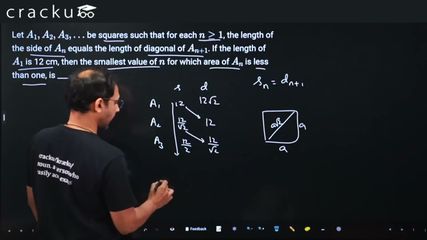
Let $$A_1, A_2, A_3, \ldots$$ be squares such that for each $$n \geq 1$$, the length of the side of $$A_n$$ equals the length of diagonal of $$A_{n+1}$$. If the length of $$A_1$$ is 12 cm, then the smallest value of $$n$$ for which area of $$A_n$$ is less than one, is ______
Correct Answer: 9
Let $$s_n$$ denote the side length of square $$A_n$$. The diagonal of square $$A_{n+1}$$ is $$s_{n+1}\sqrt{2}$$. Since the side of $$A_n$$ equals the diagonal of $$A_{n+1}$$, we have $$s_n = s_{n+1}\sqrt{2}$$, which gives $$s_{n+1} = \frac{s_n}{\sqrt{2}}$$.
This is a geometric sequence with common ratio $$\frac{1}{\sqrt{2}}$$, so $$s_n = \frac{12}{(\sqrt{2})^{n-1}}$$.
The area of square $$A_n$$ is $$s_n^2 = \frac{144}{(\sqrt{2})^{2(n-1)}} = \frac{144}{2^{n-1}}$$.
We need the smallest $$n$$ such that $$\frac{144}{2^{n-1}} < 1$$, which requires $$2^{n-1} > 144$$.
Computing successive powers: $$2^7 = 128 < 144$$ and $$2^8 = 256 > 144$$. So we need $$n - 1 \geq 8$$, i.e., $$n \geq 9$$.
Therefore, the smallest value of $$n$$ for which the area of $$A_n$$ is less than one is $$9$$.
Was this solution helpful?
Click on the Email ☝️ to Watch the Video Solution
Create a FREE account and get:
_1.webp)

Educational materials for JEE preparation

Ask our AI anything

AI can make mistakes. Please verify important information.
AI can make mistakes. Please verify important information.
