
Join Our JEE Preparation Group
Prep with like-minded aspirants; Get access to free daily tests and study material.
Sign in
Please select an account to continue using cracku.in
↓ →
Join Our JEE Preparation Group
Prep with like-minded aspirants; Get access to free daily tests and study material.
Let $$a_1, a_2, a_3, \ldots$$ be in an arithmetic progression of positive terms. Let $$A_k = a_1^2 - a_2^2 + a_3^2 - a_4^2 + \ldots + a_{2k-1}^2 - a_{2k}^2$$. If $$A_3 = -153, A_5 = -435$$ and $$a_1^2 + a_2^2 + a_3^2 = 66$$, then $$a_{17} - A_7$$ is equal to ______
Correct Answer: 910
Let's simplify the expression for $$A_k$$ first, as this is a classic pattern in A.P. series problems.
Notice that consecutive terms in $$A_k$$ form a difference of squares. We can pair them up:
$$A_k = (a_1^2 - a_2^2) + (a_3^2 - a_4^2) + \dots + (a_{2k-1}^2 - a_{2k}^2)$$
Apply the identity $$a^2 - b^2 = (a-b)(a+b)$$ to each pair:
$$A_k = (a_1 - a_2)(a_1 + a_2) + (a_3 - a_4)(a_3 + a_4) + \dots + (a_{2k-1} - a_{2k})(a_{2k-1} + a_{2k})$$
Since $$a_1, a_2, a_3 \dots$$ are in an A.P. with common difference $$d$$, the difference between any term and the next consecutive term is always $$-d$$ (i.e., $$a_n - a_{n+1} = -d$$).
We can factor out this $$-d$$ from every pair:
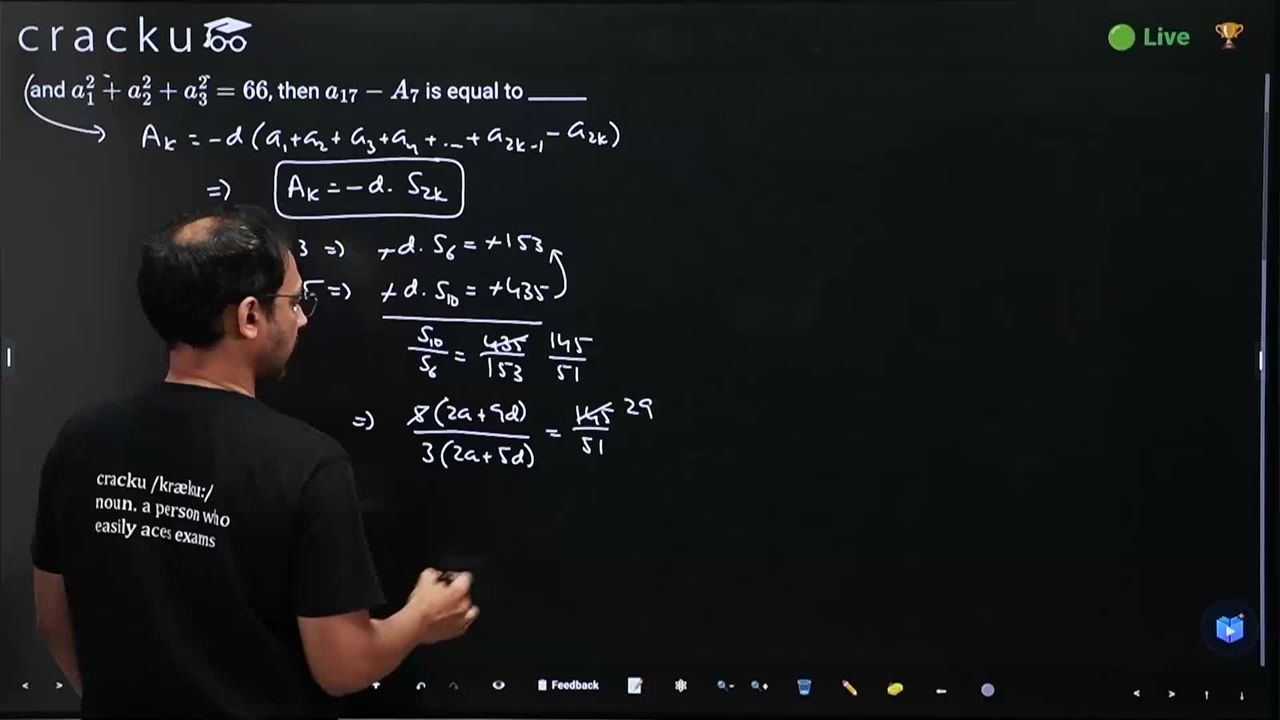
$$A_k = -d(a_1 + a_2) - d(a_3 + a_4) - \dots - d(a_{2k-1} + a_{2k})$$
$$A_k = -d [a_1 + a_2 + a_3 + \dots + a_{2k}]$$
The bracket is simply the sum of the first $$2k$$ terms of the A.P.
Using the standard summation formula $$S_n = \frac{n}{2}[2a_1 + (n-1)d]$$ for $$n = 2k$$:
$$A_k = -d \left[ \frac{2k}{2} (2a_1 + (2k-1)d) \right]$$
$$A_k = -dk (2a_1 + (2k-1)d)$$
Now, let's use the given values for $$A_3$$ and $$A_5$$:
$$A_3 = -3d (2a_1 + 5d) = -153$$
$$\implies d(2a_1 + 5d) = 51$$ --- (Equation 1)
$$A_5 = -5d (2a_1 + 9d) = -435$$
$$\implies d(2a_1 + 9d) = 87$$ --- (Equation 2)
To solve for $$d$$, subtract Equation 1 from Equation 2:
$$[d(2a_1) + 9d^2] - [d(2a_1) + 5d^2] = 87 - 51$$
$$4d^2 = 36 \implies d^2 = 9 \implies d = \pm 3$$
Since we are given an A.P. of positive terms, and the terms clearly need to increase for the sum $$A_k$$ to be negative, the common difference $$d$$ must be positive. So, $$d = 3$$.
Substitute $$d = 3$$ back into Equation 1 to find $$a_1$$:
$$3(2a_1 + 5(3)) = 51$$
$$2a_1 + 15 = 17 \implies 2a_1 = 2 \implies a_1 = 1$$
Let's quickly verify this with the third given condition: $$a_1^2 + a_2^2 + a_3^2 = 66$$.
If $$a_1 = 1$$ and $$d = 3$$, the first three terms are $$1, 4, 7$$.
$$1^2 + 4^2 + 7^2 = 1 + 16 + 49 = 66$$.
It matches perfectly!
Finally, calculate the required value $$a_{17} - A_7$$:
$$a_{17} - A_7 = 49 - (-861) = 49 + 861 = 910$$
Was this solution helpful?
Click on the Email ☝️ to Watch the Video Solution
Create a FREE account and get:
_1.webp)

Educational materials for JEE preparation

Ask our AI anything

AI can make mistakes. Please verify important information.
AI can make mistakes. Please verify important information.
