
Join Our JEE Preparation Group
Prep with like-minded aspirants; Get access to free daily tests and study material.
Sign in
Please select an account to continue using cracku.in
↓ →
Join Our JEE Preparation Group
Prep with like-minded aspirants; Get access to free daily tests and study material.
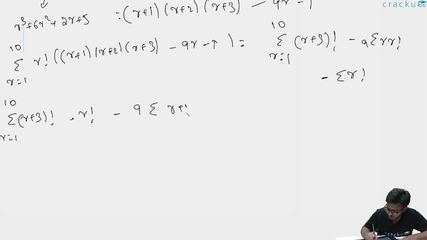
If $$\sum_{r=1}^{10} r!(r^3 + 6r^2 + 2r + 5) = \alpha(11!)$$, then the value of $$\alpha$$ is equal to ___.
Correct Answer: 160
We decompose the expression $$r^3 + 6r^2 + 2r + 5$$. Since $$(r+1)(r+2)(r+3) = r^3 + 6r^2 + 11r + 6$$, we have $$r^3 + 6r^2 + 2r + 5 = (r+1)(r+2)(r+3) - 9r - 1$$.
Multiplying by $$r!$$ gives $$r!(r^3 + 6r^2 + 2r + 5) = r!(r+1)(r+2)(r+3) - 9r \cdot r! - r!$$. Now $$r!(r+1)(r+2)(r+3) = (r+3)!$$, and using the identity $$r \cdot r! = (r+1)! - r!$$, we get $$(r+3)! - 9[(r+1)! - r!] - r! = (r+3)! - 9(r+1)! + 8 \cdot r!$$.
Each of the three sums telescopes when summed from $$r = 1$$ to $$10$$. For the first: $$\sum_{r=1}^{10}(r+3)! = 4! + 5! + \cdots + 13!$$. For the second: $$9\sum_{r=1}^{10}(r+1)! = 9(2! + 3! + \cdots + 11!)$$. For the third: $$8\sum_{r=1}^{10}r! = 8(1! + 2! + \cdots + 10!)$$.
We compute each sum step by step. Writing $$A_n = 1! + 2! + \cdots + n!$$, we have $$A_{10} = 4{,}037{,}913$$. Then: $$\sum_{r=1}^{10}(r+3)! = A_{13} - A_3 = (A_{10} + 11! + 12! + 13!) - (1! + 2! + 3!) = 4{,}037{,}913 + 39{,}916{,}800 + 479{,}001{,}600 + 6{,}227{,}020{,}800 - 9 = 6{,}749{,}977{,}104$$. Similarly, $$9 \cdot (A_{11} - A_1) = 9(4{,}037{,}913 + 39{,}916{,}800 - 1) = 9 \times 43{,}954{,}712 = 395{,}592{,}408$$. And $$8 \cdot A_{10} = 8 \times 4{,}037{,}913 = 32{,}303{,}304$$.
Therefore the total sum is $$6{,}749{,}977{,}104 - 395{,}592{,}408 + 32{,}303{,}304 = 6{,}386{,}688{,}000$$. Since $$11! = 39{,}916{,}800$$, we get $$\alpha = \dfrac{6{,}386{,}688{,}000}{39{,}916{,}800} = 160$$.
Was this solution helpful?
Click on the Email ☝️ to Watch the Video Solution
Create a FREE account and get:
_1.webp)

Educational materials for JEE preparation

Ask our AI anything

AI can make mistakes. Please verify important information.
AI can make mistakes. Please verify important information.
