
Join Our JEE Preparation Group
Prep with like-minded aspirants; Get access to free daily tests and study material.
Sign in
Please select an account to continue using cracku.in
↓ →
Join Our JEE Preparation Group
Prep with like-minded aspirants; Get access to free daily tests and study material.
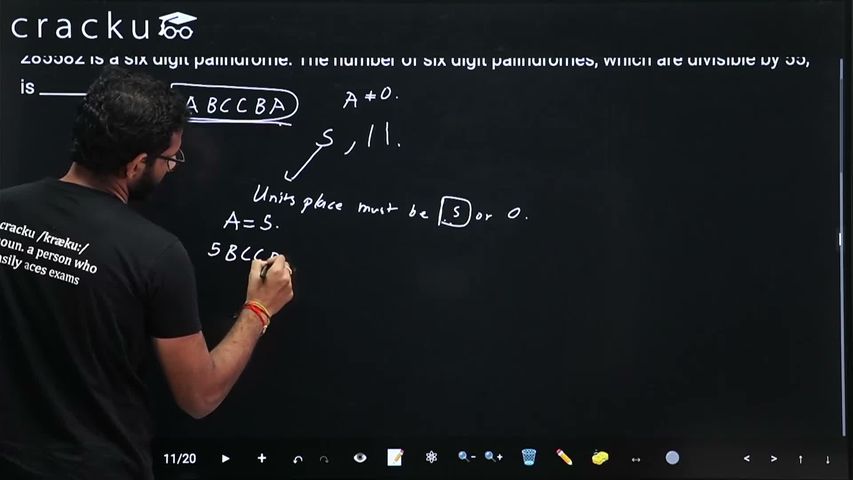
A number is called a palindrome if it reads the same backward as well as forward. For example 285582 is a six digit palindrome. The number of six digit palindromes, which are divisible by 55, is _________.
Correct Answer: 100
First, recall that a six-digit palindrome has the form $$\overline{ABC CBA},$$ where the first three digits $$A,B,C$$ are repeated in reverse order to give the last three digits. Writing this number in expanded form, we have
$$\overline{ABC CBA}=100000A+10000B+1000C+100C+10B+A.$$
Simplifying the powers of ten,
$$100000A+10000B+1000C+100C+10B+A=100001A+10010B+1100C.$$
We need those six-digit palindromes that are divisible by $$55.$$ Because $$55=5\times 11,$$ a number is divisible by $$55$$ if and only if it is simultaneously divisible by $$5$$ and by $$11.$$ We shall impose these two conditions one by one.
Condition for divisibility by 5. A decimal number is divisible by $$5$$ exactly when its last digit is either $$0$$ or $$5.$$ In our palindrome, the last digit is $$A,$$ and the first digit is the same $$A.$$ Since we require a six-digit number, the leading digit cannot be zero. Therefore
$$A=5.$$
So every six-digit palindrome divisible by $$5$$ must begin and end with the digit $$5.$$ No other choice of $$A$$ is possible.
Condition for divisibility by 11. The well-known test for divisibility by $$11$$ states: “A number is divisible by $$11$$ if and only if the absolute difference between the sum of the digits in odd positions and the sum of the digits in even positions is a multiple of $$11.$$”
Label the positions of the digits from the left as 1 through 6. Our palindrome with digits $$A,B,C,C,B,A$$ then has
Odd positions (1, 3, 5): $$A,\;C,\;B,$$ so $$\text{Sum}_{\text{odd}} = A+C+B.$$ Even positions (2, 4, 6): $$B,\;C,\;A,$$ so $$\text{Sum}_{\text{even}} = B+C+A.$$ Clearly
$$\text{Sum}_{\text{odd}}-\text{Sum}_{\text{even}}=(A+C+B)-(B+C+A)=0,$$
and $$0$$ is a multiple of $$11.$$ Hence every six-digit palindrome automatically satisfies the divisibility-by-11 condition, no matter what the values of $$B$$ and $$C$$ might be.
Counting the possibilities. • We have already fixed $$A=5$$ to meet the divisibility-by-5 requirement. • The digit $$B$$ can be any digit from $$0$$ to $$9,$$ giving $$10$$ possible values. • The digit $$C$$ can also be any digit from $$0$$ to $$9,$$ giving another $$10$$ possible values.
Because the choices of $$B$$ and $$C$$ are independent, the total number of distinct six-digit palindromes satisfying both conditions is
$$1 \text{ (choice for }A)\times 10 \text{ (choices for }B)\times 10 \text{ (choices for }C)=100.$$
So, the answer is $$100$$.
Was this solution helpful?
Click on the Email ☝️ to Watch the Video Solution
Create a FREE account and get:
_1.webp)

Educational materials for JEE preparation

Ask our AI anything

AI can make mistakes. Please verify important information.
AI can make mistakes. Please verify important information.
