
Join Our JEE Preparation Group
Prep with like-minded aspirants; Get access to free daily tests and study material.
Sign in
Please select an account to continue using cracku.in
↓ →
Join Our JEE Preparation Group
Prep with like-minded aspirants; Get access to free daily tests and study material.
There are 4 men and 5 women in Group A, and 5 men and 4 women in Group B. If 4 persons are selected from each group, then the number of ways of selecting 4 men and 4 women is _____
Correct Answer: 5626
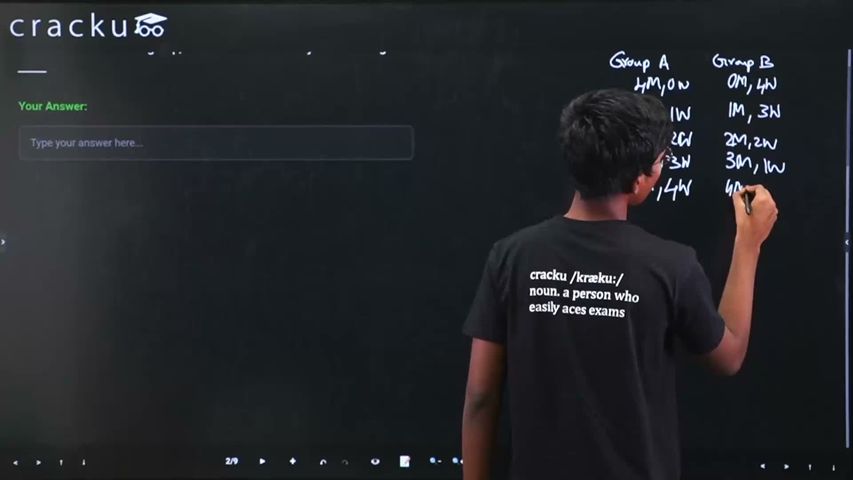
Select 4 from Group A (4M, 5W) and 4 from Group B (5M, 4W) such that the total is 4 men and 4 women.
Let $$k$$ men be selected from Group A, which means $$4-k$$ women are chosen from Group A. Since the overall requirement is 4 men and 4 women, from Group B one must select $$4-k$$ men and $$k$$ women.
The parameter $$k$$ must satisfy $$0 \le k \le 4$$ for men in Group A, $$4-k \le 5$$ for women in Group A, $$4-k \le 5$$ for men in Group B, and $$k \le 4$$ for women in Group B. These conditions hold for $$k=0,1,2,3,4$$.
Therefore the total number of ways is given by
$$N = \sum_{k=0}^{4} \binom{4}{k}\binom{5}{4-k}\binom{5}{4-k}\binom{4}{k}$$
For $$k=0$$, the count is $$\binom{4}{0}\binom{5}{4}\binom{5}{4}\binom{4}{0} = 1 \times 5 \times 5 \times 1 = 25$$
For $$k=1$$, the count is $$\binom{4}{1}\binom{5}{3}\binom{5}{3}\binom{4}{1} = 4 \times 10 \times 10 \times 4 = 1600$$
For $$k=2$$, the count is $$\binom{4}{2}\binom{5}{2}\binom{5}{2}\binom{4}{2} = 6 \times 10 \times 10 \times 6 = 3600$$
For $$k=3$$, the count is $$\binom{4}{3}\binom{5}{1}\binom{5}{1}\binom{4}{3} = 4 \times 5 \times 5 \times 4 = 400$$
For $$k=4$$, the count is $$\binom{4}{4}\binom{5}{0}\binom{5}{0}\binom{4}{4} = 1 \times 1 \times 1 \times 1 = 1$$
Summing these gives $$N = 25 + 1600 + 3600 + 400 + 1 = 5626$$
The correct answer is 5626.
Was this solution helpful?
Click on the Email ☝️ to Watch the Video Solution
Create a FREE account and get:
_1.webp)

Educational materials for JEE preparation

Ask our AI anything

AI can make mistakes. Please verify important information.
AI can make mistakes. Please verify important information.
