
Join Our JEE Preparation Group
Prep with like-minded aspirants; Get access to free daily tests and study material.
Sign in
Please select an account to continue using cracku.in
↓ →
Join Our JEE Preparation Group
Prep with like-minded aspirants; Get access to free daily tests and study material.
The sum of all integral values of $$k$$ ($$k \neq 0$$) for which the equation $$\frac{2}{x-1} - \frac{1}{x-2} = \frac{2}{k}$$ in $$x$$ has no real roots, is _________
Correct Answer: 66
We begin with the given equation
$$\frac{2}{x-1}-\frac{1}{x-2}=\frac{2}{k},\qquad k\neq 0.$$
To clear the fractions we first take the common denominator on the left side. The common denominator of the two fractions is $$(x-1)(x-2).$$ Hence
$$\frac{2}{x-1}-\frac{1}{x-2}\;=\;\frac{2(x-2)-(x-1)}{(x-1)(x-2)}.$$
Expanding the numerator we have
$$2(x-2)-(x-1)=2x-4-x+1=x-3.$$
Therefore the equation becomes
$$\frac{x-3}{(x-1)(x-2)}=\frac{2}{k}.$$
Now we cross-multiply (which is allowed because none of the denominators is zero when a solution is valid):
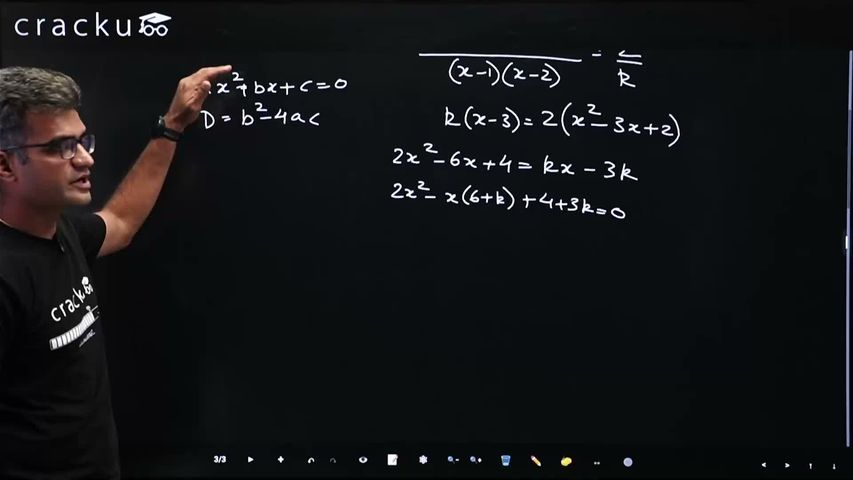
$$k(x-3)=2\,(x-1)(x-2).$$
Next we expand the right-hand side. First note that
$$(x-1)(x-2)=x^2-3x+2.$$
Multiplying by the factor $$2$$ we get
$$2(x-1)(x-2)=2x^2-6x+4.$$
So the cross-multiplied equation is
$$k(x-3)=2x^2-6x+4.$$
We now bring every term to one side to form a quadratic equation in $$x$$. Distributing $$k$$ on the left gives
$$kx-3k=2x^2-6x+4.$$
Subtracting the left-hand side from both sides gives
$$0=2x^2-6x+4-kx+3k.$$
Grouping like terms in $$x$$ we write
$$0=2x^2-(k+6)x+(3k+4).$$
Thus the quadratic in standard form is
$$2x^2-(k+6)x+(3k+4)=0.$$
The quadratic formula tells us that a quadratic equation $$ax^2+bx+c=0$$ has real roots precisely when its discriminant $$\Delta=b^2-4ac$$ is non-negative. We want no real roots, so we require $$\Delta\lt 0.$$
Here $$a=2,\; b=-(k+6),\; c=3k+4.$$ Hence
$$\Delta=(-(k+6))^2-4\cdot2\cdot(3k+4).$$
Calculating each part we get
$$(k+6)^2=k^2+12k+36,$$
and
$$4\cdot2\cdot(3k+4)=8(3k+4)=24k+32.$$
Therefore
$$\Delta=k^2+12k+36-(24k+32)=k^2-12k+4.$$
For no real roots we need
$$k^2-12k+4\lt 0.$$
This is a quadratic inequality in $$k$$. Because the coefficient of $$k^2$$ is positive, the expression is negative between its two real roots. We find the roots by setting the quadratic equal to zero:
$$k^2-12k+4=0.$$
Using the quadratic formula with respect to $$k$$ (now $$a=1,\; b=-12,\; c=4$$) we get
$$k=\frac{12\pm\sqrt{(-12)^2-4\cdot1\cdot4}}{2}=\frac{12\pm\sqrt{144-16}}{2}=\frac{12\pm\sqrt{128}}{2}=\frac{12\pm8\sqrt2}{2}=6\pm4\sqrt2.$$
Thus the inequality $$k^2-12k+4\lt 0$$ holds for
$$6-4\sqrt2\lt k\lt 6+4\sqrt2.$$
Since $$4\sqrt2\approx5.656854,$$ the numerical bounds are approximately
$$0.343146\lt k\lt 11.656854.$$
We are asked for integral (integer) values of $$k$$ with the additional condition $$k\neq0$$. The integers that satisfy the inequality are therefore
$$k=1,2,3,4,5,6,7,8,9,10,11.$$
Adding these values we obtain
$$1+2+3+4+5+6+7+8+9+10+11=\frac{11\,(1+11)}{2}=66.$$
So, the answer is $$66$$.
Was this solution helpful?
Click on the Email ☝️ to Watch the Video Solution
Create a FREE account and get:
_1.webp)

Educational materials for JEE preparation

Ask our AI anything

AI can make mistakes. Please verify important information.
AI can make mistakes. Please verify important information.
