
Join Our JEE Preparation Group
Prep with like-minded aspirants; Get access to free daily tests and study material.
Sign in
Please select an account to continue using cracku.in
↓ →
Join Our JEE Preparation Group
Prep with like-minded aspirants; Get access to free daily tests and study material.
Let A and B be independent events such that P(A) = p, P(B) = 2p. The largest value of p, for which P(exactly one of A, B occurs) = $$\frac{5}{9}$$, is:
We have two independent events A and B with probabilities $$P(A)=p$$ and $$P(B)=2p$$. Because the events are independent, their complements are also independent. Our first task is to express the probability that exactly one of the two events occurs.
By definition, “exactly one of A or B occurs” means the outcome is either “A occurs and B does not” or “B occurs and A does not.” For independent events, we use the multiplication rule $$P(X\cap Y)=P(X)\,P(Y)$$. Hence
$$P(\text{exactly one of }A,B)=P(A\cap B')+P(B\cap A').$$
Substituting the given probabilities and the complements $$P(B')=1-P(B) \quad\text{and}\quad P(A')=1-P(A),$$ we write
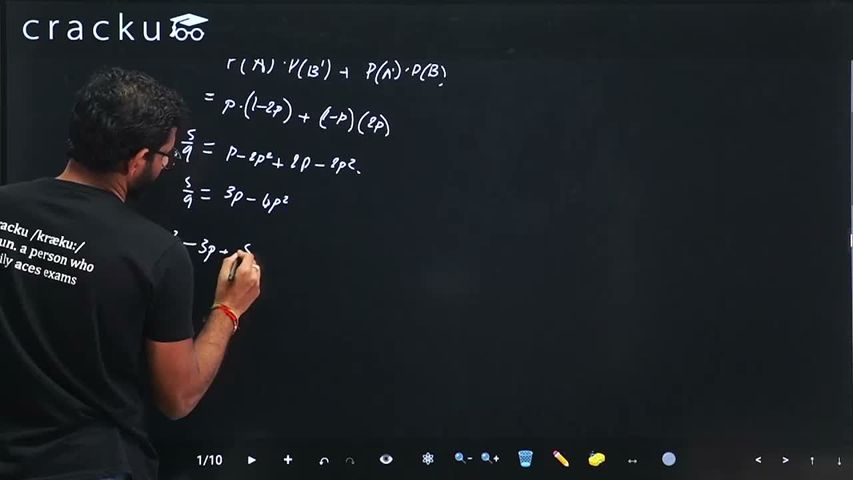
$$P(\text{exactly one}) \;=\; P(A)\,P(B') + P(B)\,P(A')$$
$$=\; p\,[1-2p] + (2p)\,[1-p].$$
Expanding each product gives
$$p(1-2p)=p-2p^{2},$$
$$2p(1-p)=2p-2p^{2}.$$
Adding these two expressions we obtain
$$P(\text{exactly one})=(p-2p^{2})+(2p-2p^{2})$$ $$=p-2p^{2}+2p-2p^{2}$$ $$=3p-4p^{2}.$$
The problem states that this probability equals $$\dfrac59$$. Therefore we set
$$3p-4p^{2}=\dfrac59.$$
To clear the fraction, multiply both sides by 9:
$$9(3p-4p^{2})=5,$$ $$27p-36p^{2}=5.$$
Now bring all terms to one side to form a quadratic equation in the standard form $$ax^{2}+bx+c=0$$:
$$-36p^{2}+27p-5=0.$$
Multiplying by -1 (so the leading coefficient is positive) yields
$$36p^{2}-27p+5=0.$$
We next solve this quadratic equation using the quadratic formula. Recall the formula:
For $$ax^{2}+bx+c=0,$$ the roots are $$x=\dfrac{-b\pm\sqrt{b^{2}-4ac}}{2a}.$$
Here, $$a=36,\; b=-27,\; c=5$$ (note that b is -27 because the middle term is -27p). Substituting:
Discriminant
$$\Delta=b^{2}-4ac=(-27)^{2}-4(36)(5)=729-720=9.$$
Square root of the discriminant
$$\sqrt{\Delta}=\sqrt{9}=3.$$
Now the two possible roots are
$$p=\dfrac{-(-27)\pm 3}{2\cdot 36}=\dfrac{27\pm 3}{72}.$$
Simplifying each root:
First root: $$p_{1}=\dfrac{27+3}{72}=\dfrac{30}{72}=\dfrac{5}{12}.$$
Second root: $$p_{2}=\dfrac{27-3}{72}=\dfrac{24}{72}=\dfrac{1}{3}.$$
Probabilities must satisfy $$0\le p\le 1$$ and, because $$P(B)=2p,$$ we also need $$2p\le 1,$$ or $$p\le\dfrac12.$$ Both values $$\dfrac{5}{12}\;(=0.416\dots)$$ and $$\dfrac13\;(=0.333\dots)$$ lie in the allowed interval. The question asks for the largest such value, so we choose
$$p=\dfrac{5}{12}.$$
Comparing with the options given, $$\dfrac{5}{12}$$ corresponds to Option C.
Hence, the correct answer is Option C.
Was this solution helpful?
Click on the Email ☝️ to Watch the Video Solution
Create a FREE account and get:
_1.webp)

Educational materials for JEE preparation

Ask our AI anything

AI can make mistakes. Please verify important information.
AI can make mistakes. Please verify important information.
