
Join Our JEE Preparation Group
Prep with like-minded aspirants; Get access to free daily tests and study material.
Sign in
Please select an account to continue using cracku.in
↓ →
Join Our JEE Preparation Group
Prep with like-minded aspirants; Get access to free daily tests and study material.
A plane $$P$$ contains the line $$x + 2y + 3z + 1 = 0 = x - y - z - 6$$, and is perpendicular to the plane $$-2x + y + z + 8 = 0$$. Then which of the following points lies on $$P$$?
We are asked to find a plane $$P$$ which (i) contains the line given by the simultaneous equations $$x + 2y + 3z + 1 = 0$$ and $$x - y - z - 6 = 0$$ and (ii) is perpendicular to the plane $$-2x + y + z + 8 = 0$$. Finally, we must decide which of the listed points lies on that plane.
First, recall that all planes passing through a given line can be written as a linear combination of the two plane‐equations that define the line. Hence the general equation of any plane through our line is
$$\bigl(x + 2y + 3z + 1\bigr) + k\bigl(x - y - z - 6\bigr) = 0,$$
where $$k$$ is a real parameter. Expanding and collecting like terms we obtain
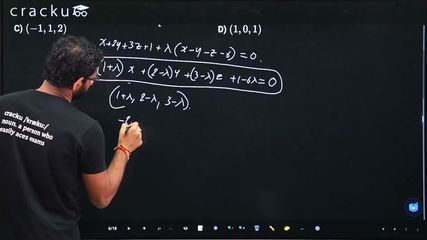
$$\;(1 + k)\,x + (2 - k)\,y + (3 - k)\,z + (1 - 6k) = 0.$$
This is the family of planes containing the required line. Let us denote the normal vector of this plane by
$$\mathbf n_1 = \bigl(1 + k,\; 2 - k,\; 3 - k\bigr).$$
Next, the given plane $$-2x + y + z + 8 = 0$$ has normal vector
$$\mathbf n_2 = (-2,\; 1,\; 1).$$
The condition for two planes to be perpendicular is that their normals are perpendicular, i.e. their dot product must vanish. Stating the formula, for vectors $$\mathbf a = (a_1,a_2,a_3)$$ and $$\mathbf b = (b_1,b_2,b_3)$$ we have
$$\mathbf a \cdot \mathbf b = a_1b_1 + a_2b_2 + a_3b_3.$$
Applying this here we set
$$\mathbf n_1 \cdot \mathbf n_2 = 0.$$
So we compute
$$\begin{aligned} (1 + k)(-2) \;+\; (2 - k)(1) \;+\; (3 - k)(1) &= 0,\\[4pt] -2(1 + k) + (2 - k) + (3 - k) &= 0,\\[4pt] -2 - 2k + 2 - k + 3 - k &= 0,\\[4pt] 3 - 4k &= 0. \end{aligned}$$
Solving the last equation gives
$$k = \dfrac{3}{4}.$$
Substituting this value of $$k$$ back into the coefficients of the plane we find
$$\begin{aligned} 1 + k &= 1 + \dfrac34 = \dfrac74,\\[4pt] 2 - k &= 2 - \dfrac34 = \dfrac54,\\[4pt] 3 - k &= 3 - \dfrac34 = \dfrac94,\\[4pt] 1 - 6k &= 1 - 6\!\left(\dfrac34\right) = 1 - \dfrac{18}{4} = -\dfrac72. \end{aligned}$$
Hence the required plane $$P$$ is
$$\frac74\,x + \frac54\,y + \frac94\,z - \frac72 = 0.$$
To clear the denominators we multiply the entire equation by $$4$$, obtaining
$$7x + 5y + 9z - 14 = 0.$$
Now we test each option by substituting the coordinates into this equation.
Option A: $$(2,-1,1)$$ gives $$7(2) + 5(-1) + 9(1) - 14 = 14 - 5 + 9 - 14 = 4 \neq 0.$$ So it is not on $$P$$.
Option B: $$(0,1,1)$$ gives $$7(0) + 5(1) + 9(1) - 14 = 0,$$ hence this point does satisfy the plane equation.
Option C: $$(-1,1,2)$$ gives $$7(-1) + 5(1) + 9(2) - 14 = -7 + 5 + 18 - 14 = 2 \neq 0.$$
Option D: $$(1,0,1)$$ gives $$7(1) + 5(0) + 9(1) - 14 = 2 \neq 0.$$
Only Option B satisfies the plane equation.
Hence, the correct answer is Option 2.
Was this solution helpful?
Click on the Email ☝️ to Watch the Video Solution
Create a FREE account and get:
_1.webp)

Educational materials for JEE preparation

Ask our AI anything

AI can make mistakes. Please verify important information.
AI can make mistakes. Please verify important information.
