
Join Our JEE Preparation Group
Prep with like-minded aspirants; Get access to free daily tests and study material.
Sign in
Please select an account to continue using cracku.in
↓ →
Join Our JEE Preparation Group
Prep with like-minded aspirants; Get access to free daily tests and study material.
Let $$z = \frac{1-i\sqrt{3}}{2}$$, $$i = \sqrt{-1}$$. Then the value of $$$21 + \left(z + \frac{1}{z}\right)^3 + \left(z^2 + \frac{1}{z^2}\right)^3 + \left(z^3 + \frac{1}{z^3}\right)^3 + \ldots + \left(z^{21} + \frac{1}{z^{21}}\right)^3$$$ is _________
Correct Answer: 13
We have $$z=\dfrac{1-i\sqrt 3}{2}$$ and $$i=\sqrt{-1}\,.$$
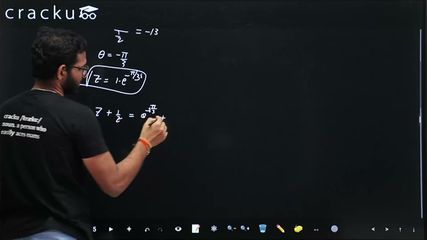
First we find the modulus and argument of $$z$$. The modulus is
$$$|z|=\sqrt{\left(\dfrac12\right)^2+\left(\dfrac{-\sqrt3}{2}\right)^2}= \sqrt{\dfrac14+\dfrac34}= \sqrt1 =1.$$$
Because $$|z|=1$$, the number lies on the unit circle. Writing $$z=x+iy$$, we have $$x=\dfrac12$$ and $$y=-\dfrac{\sqrt3}{2}$$, so
$$\cos\theta=\dfrac12,\qquad\sin\theta=-\dfrac{\sqrt3}{2}.$$
These are the cosine and sine of $$-\dfrac{\pi}{3}$$. Hence
$$z=e^{-i\pi/3}.$$
For every positive integer $$k$$ we therefore get
$$$z^{\,k}=e^{-ik\pi/3},\qquad \dfrac1{z^{\,k}}=e^{ik\pi/3}.$$$
Adding these two expressions gives the well-known Euler relation
$$$z^{\,k}+\dfrac1{z^{\,k}}=e^{-ik\pi/3}+e^{ik\pi/3}=2\cos\!\left(\dfrac{k\pi}{3}\right).$$$
Now we cube both sides:
$$$\left(z^{\,k}+\dfrac1{z^{\,k}}\right)^3=\left(2\cos\!\left(\dfrac{k\pi}{3}\right)\right)^3 =8\cos^3\!\left(\dfrac{k\pi}{3}\right).$$$
The expression asked in the question is
$$$S=21+\sum_{k=1}^{21}\left(z^{\,k}+\dfrac1{z^{\,k}}\right)^3 =21+\sum_{k=1}^{21}8\cos^3\!\left(\dfrac{k\pi}{3}\right).$$$
Taking the constant $$8$$ outside the summation we get
$$S=21+8\sum_{k=1}^{21}\cos^3\!\left(\dfrac{k\pi}{3}\right).$$
To evaluate the trigonometric sum, we note that $$\cos\theta$$ has period $$2\pi$$, so $$\cos^3\theta$$ is also periodic with period $$2\pi$$. An increment of $$\theta$$ by $$\dfrac{\pi}{3}$$ corresponds to increasing $$k$$ by $$1$$. Hence every six successive values of $$k$$ produce one complete period:
$$$k=0,1,2,3,4,5 \quad\Longrightarrow\quad \theta=0,\dfrac{\pi}{3},\dfrac{2\pi}{3},\pi,\dfrac{4\pi}{3},\dfrac{5\pi}{3}.$$$
We list the individual cube values within one period:
$$$ \begin{aligned} k=0:&\;\cos^3 0 = 1,\\ k=1:&\;\cos^3\!\left(\dfrac{\pi}{3}\right)=\left(\dfrac12\right)^3=\dfrac18,\\ k=2:&\;\cos^3\!\left(\dfrac{2\pi}{3}\right)=\left(-\dfrac12\right)^3=-\dfrac18,\\ k=3:&\;\cos^3\pi = (-1)^3=-1,\\ k=4:&\;\cos^3\!\left(\dfrac{4\pi}{3}\right)=\left(-\dfrac12\right)^3=-\dfrac18,\\ k=5:&\;\cos^3\!\left(\dfrac{5\pi}{3}\right)=\left(\dfrac12\right)^3=\dfrac18. \end{aligned} $$$
Adding these six numbers gives
$$1+\dfrac18-\dfrac18-1-\dfrac18+\dfrac18 = 0.$$
Thus the sum of $$\cos^3\!\left(\dfrac{k\pi}{3}\right)$$ over any block of six consecutive integers $$k$$ is zero.
From $$k=1$$ to $$k=21$$ we have three full blocks of six terms (for $$k=1\text{ to }18$$) and then three extra terms (for $$k=19,20,21$$).
The three complete blocks contribute
$$3\times 0 = 0.$$
We now calculate the remaining three terms explicitly:
$$$ \begin{aligned} k=19:&\;19\bmod 6=1\;\Rightarrow\;\cos^3\!\left(\dfrac{19\pi}{3}\right)=\cos^3\!\left(\dfrac{\pi}{3}\right)=\dfrac18,\\ k=20:&\;20\bmod 6=2\;\Rightarrow\;\cos^3\!\left(\dfrac{20\pi}{3}\right)=\cos^3\!\left(\dfrac{2\pi}{3}\right)=-\dfrac18,\\ k=21:&\;21\bmod 6=3\;\Rightarrow\;\cos^3\!\left(\dfrac{21\pi}{3}\right)=\cos^3\pi=-1. \end{aligned} $$$
Adding these residual values gives
$$\dfrac18-\dfrac18-1=-1.$$
Therefore the complete trigonometric sum is
$$\sum_{k=1}^{21}\cos^3\!\left(\dfrac{k\pi}{3}\right) = -1.$$
Substituting back into $$S$$ we obtain
$$$S = 21 + 8(-1) = 21 - 8 = 13.$$$
So, the answer is $$13$$.
Was this solution helpful?
Click on the Email ☝️ to Watch the Video Solution
Create a FREE account and get:
_1.webp)

Educational materials for JEE preparation

Ask our AI anything

AI can make mistakes. Please verify important information.
AI can make mistakes. Please verify important information.
