
Join Our JEE Preparation Group
Prep with like-minded aspirants; Get access to free daily tests and study material.
Sign in
Please select an account to continue using cracku.in
↓ →
Join Our JEE Preparation Group
Prep with like-minded aspirants; Get access to free daily tests and study material.
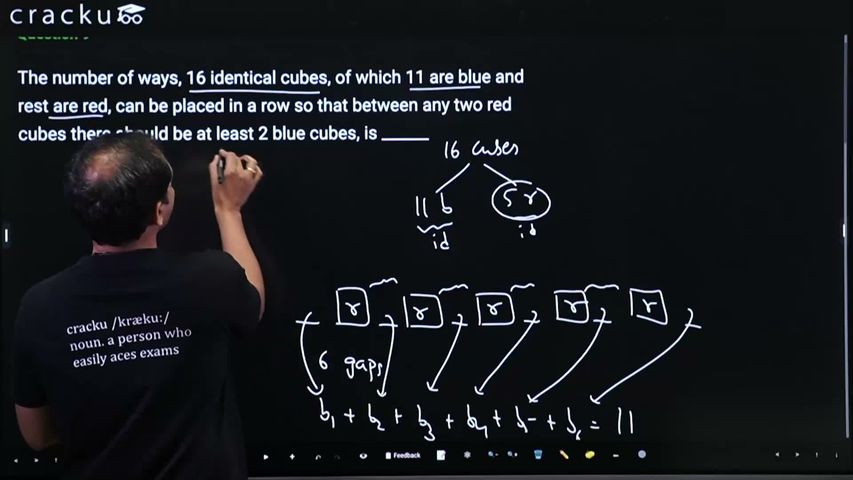
The number of ways, 16 identical cubes, of which 11 are blue and rest are red, can be placed in a row so that between any two red cubes there should be at least 2 blue cubes, is ______
Correct Answer: 56
We need to arrange 16 cubes (11 blue, 5 red) in a row such that between any two red cubes there are at least 2 blue cubes.
First, we place all 11 blue cubes in a row. This creates 12 gaps (including ends): $$\_B\_B\_B\_B\_B\_B\_B\_B\_B\_B\_B\_$$
Since the condition requires at least 2 blue cubes between consecutive red cubes, we can model this using a change of variable.
Let us place the 5 red cubes among the 11 blue cubes. Let $$b_0, b_1, b_2, b_3, b_4, b_5$$ be the number of blue cubes before the first red, between consecutive red cubes, and after the last red respectively.
We need: $$b_0 + b_1 + b_2 + b_3 + b_4 + b_5 = 11$$ with $$b_1, b_2, b_3, b_4 \geq 2$$ and $$b_0, b_5 \geq 0$$.
Substituting to remove these constraints, let $$b_i' = b_i - 2$$ for $$i = 1, 2, 3, 4$$. Then $$b_i' \geq 0$$ and:
$$b_0 + (b_1' + 2) + (b_2' + 2) + (b_3' + 2) + (b_4' + 2) + b_5 = 11$$
$$b_0 + b_1' + b_2' + b_3' + b_4' + b_5 = 11 - 8 = 3$$
Now, the number of non-negative integer solutions to $$b_0 + b_1' + b_2' + b_3' + b_4' + b_5 = 3$$ (6 variables) is:
$$\binom{3 + 6 - 1}{6 - 1} = \binom{8}{5} = 56$$
The answer is $$\boxed{56}$$.
Was this solution helpful?
Click on the Email ☝️ to Watch the Video Solution
Create a FREE account and get:
_1.webp)

Educational materials for JEE preparation

Ask our AI anything

AI can make mistakes. Please verify important information.
AI can make mistakes. Please verify important information.
