
Join Our JEE Preparation Group
Prep with like-minded aspirants; Get access to free daily tests and study material.
Sign in
Please select an account to continue using cracku.in
↓ →
Join Our JEE Preparation Group
Prep with like-minded aspirants; Get access to free daily tests and study material.
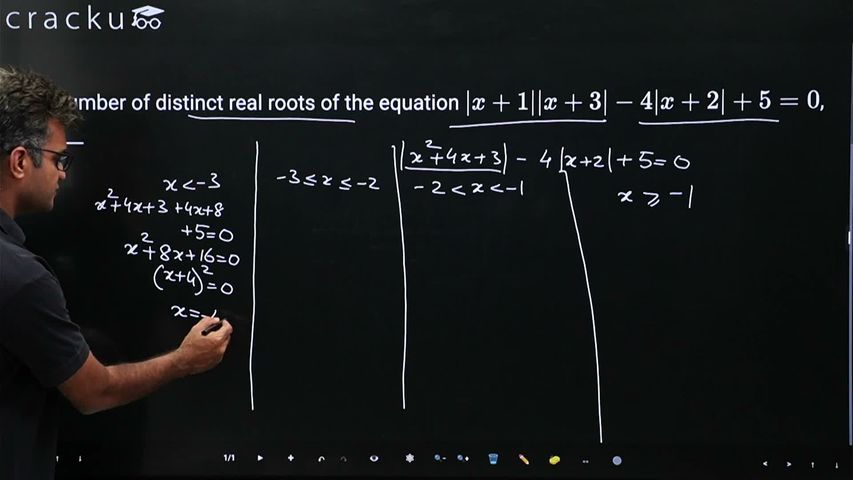
The number of distinct real roots of the equation $$|x + 1||x + 3| - 4|x + 2| + 5 = 0$$, is _____
Correct Answer: 2
We need to find the number of distinct real roots of:
$$|x + 1||x + 3| - 4|x + 2| + 5 = 0$$
The critical points of the absolute value expressions are at $$x = -3$$, $$x = -2$$, and $$x = -1$$. These divide the real line into four intervals. In each interval, every absolute value expression has a definite sign, so we can remove the absolute values and solve.
Case 1: $$x \geq -1$$
In this interval, $$x + 1 \geq 0$$, $$x + 3 > 0$$, and $$x + 2 > 0$$. So all absolute values equal the expressions themselves.
$$(x+1)(x+3) - 4(x+2) + 5 = 0$$
$$x^2 + 4x + 3 - 4x - 8 + 5 = 0$$
$$x^2 = 0 \implies x = 0$$
Since $$0 \geq -1$$, this root is valid.
Case 2: $$-2 \leq x < -1$$
Here $$x + 1 < 0$$, $$x + 3 > 0$$, and $$x + 2 \geq 0$$. So $$|x+1| = -(x+1)$$, while the other two remain positive.
$$-(x+1)(x+3) - 4(x+2) + 5 = 0$$
$$-(x^2 + 4x + 3) - 4x - 8 + 5 = 0$$
$$-x^2 - 8x - 6 = 0 \implies x^2 + 8x + 6 = 0$$
$$x = \frac{-8 \pm \sqrt{64 - 24}}{2} = -4 \pm \sqrt{10}$$
This gives $$x \approx -0.84$$ or $$x \approx -7.16$$. Neither value lies in the interval $$[-2, -1)$$, so no valid roots here.
Case 3: $$-3 \leq x < -2$$
Here $$x + 1 < 0$$, $$x + 3 \geq 0$$, and $$x + 2 < 0$$. So $$|x+1| = -(x+1)$$ and $$|x+2| = -(x+2)$$.
$$-(x+1)(x+3) - 4 \cdot (-(x+2)) + 5 = 0$$
$$-(x^2 + 4x + 3) + 4(x + 2) + 5 = 0$$
$$-x^2 - 4x - 3 + 4x + 8 + 5 = 0$$
$$-x^2 + 10 = 0 \implies x^2 = 10$$
This gives $$x = \pm\sqrt{10} \approx \pm 3.16$$. Neither lies in $$[-3, -2)$$, so no valid roots here.
Case 4: $$x < -3$$
Here all three expressions $$x + 1$$, $$x + 2$$, and $$x + 3$$ are negative. So $$|x+1| = -(x+1)$$, $$|x+3| = -(x+3)$$, and $$|x+2| = -(x+2)$$. The product of two negatives is positive:
$$(x+1)(x+3) + 4(x+2) + 5 = 0$$
$$x^2 + 4x + 3 + 4x + 8 + 5 = 0$$
$$x^2 + 8x + 16 = 0 \implies (x + 4)^2 = 0 \implies x = -4$$
Since $$-4 < -3$$, this root is valid.
Conclusion: The equation has exactly two distinct real roots: $$x = 0$$ and $$x = -4$$.
The answer is $$\textbf{2}$$.
Was this solution helpful?
Click on the Email ☝️ to Watch the Video Solution
Create a FREE account and get:
_1.webp)

Educational materials for JEE preparation

Ask our AI anything

AI can make mistakes. Please verify important information.
AI can make mistakes. Please verify important information.
