
Join Our JEE Preparation Group
Prep with like-minded aspirants; Get access to free daily tests and study material.
Sign in
Please select an account to continue using cracku.in
↓ →
Join Our JEE Preparation Group
Prep with like-minded aspirants; Get access to free daily tests and study material.
There are three bags $$X, Y$$ and $$Z$$. Bag $$X$$ contains 5 one-rupee coins and 4 five-rupee coins; Bag $$Y$$ contains 4 one-rupee coins and 5 five-rupee coins and Bag $$Z$$ contains 3 one-rupee coins and 6 five-rupee coins. A bag is selected at random and a coin drawn from it at random is found to be a one-rupee coin. Then the probability, that it came from bag Y, is :
Using Bayes' theorem to find the probability that the one-rupee coin came from Bag Y.
Let $$P(X) = P(Y) = P(Z) = \frac{1}{3}$$ (each bag equally likely).
$$P(\text{1-rupee}|X) = \frac{5}{9}$$, $$P(\text{1-rupee}|Y) = \frac{4}{9}$$, $$P(\text{1-rupee}|Z) = \frac{3}{9} = \frac{1}{3}$$.
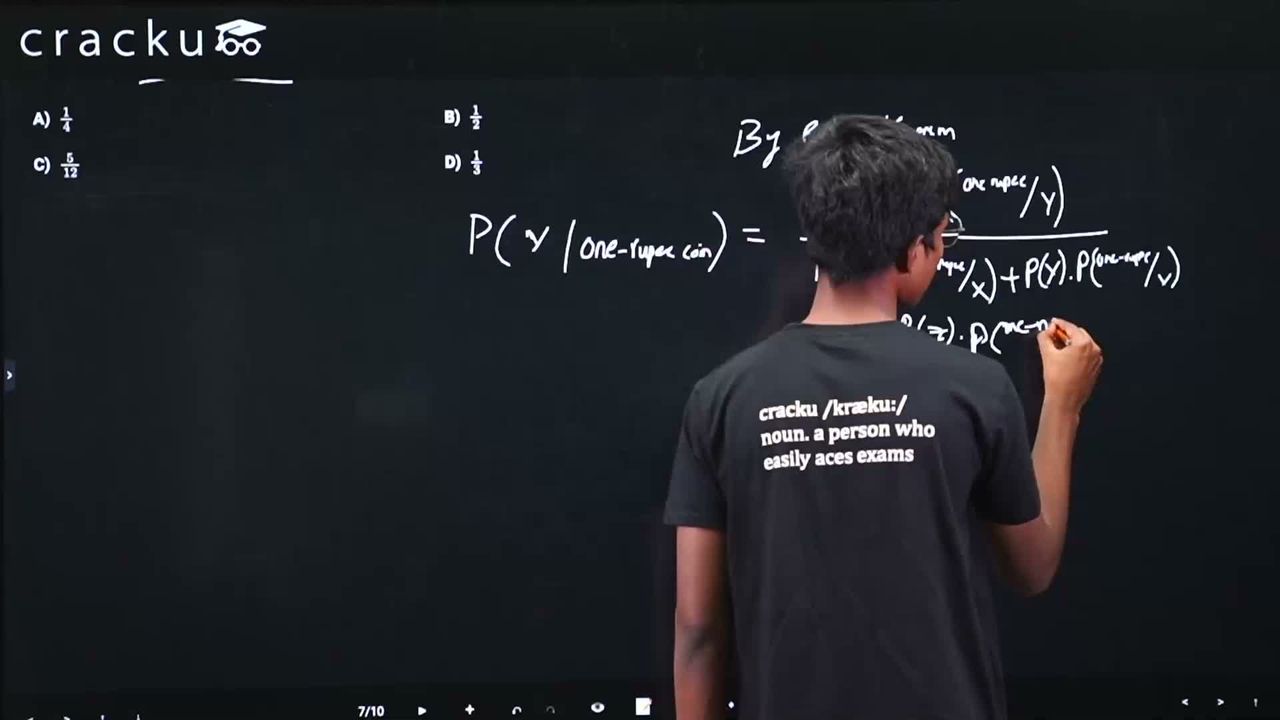
By Bayes' theorem:
$$P(Y|\text{1-rupee}) = \frac{P(\text{1-rupee}|Y) \cdot P(Y)}{P(\text{1-rupee}|X)P(X) + P(\text{1-rupee}|Y)P(Y) + P(\text{1-rupee}|Z)P(Z)}$$
$$= \frac{\frac{4}{9} \cdot \frac{1}{3}}{\frac{5}{9} \cdot \frac{1}{3} + \frac{4}{9} \cdot \frac{1}{3} + \frac{3}{9} \cdot \frac{1}{3}} = \frac{\frac{4}{27}}{\frac{5+4+3}{27}} = \frac{4}{12} = \frac{1}{3}$$
The correct answer is Option 4: $$\frac{1}{3}$$.
Was this solution helpful?
Click on the Email ☝️ to Watch the Video Solution
Create a FREE account and get:
_1.webp)

Educational materials for JEE preparation

Ask our AI anything

AI can make mistakes. Please verify important information.
AI can make mistakes. Please verify important information.
