
Join Our JEE Preparation Group
Prep with like-minded aspirants; Get access to free daily tests and study material.
Sign in
Please select an account to continue using cracku.in
↓ →
Join Our JEE Preparation Group
Prep with like-minded aspirants; Get access to free daily tests and study material.
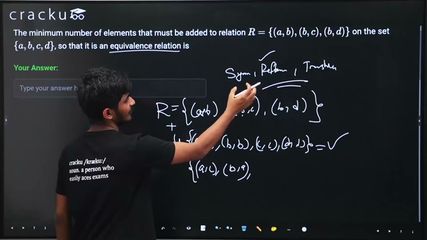
The minimum number of elements that must be added to relation $$R = \{(a,b), (b,c), (b,d)\}$$ on the set $$\{a, b, c, d\}$$, so that it is an equivalence relation is
Correct Answer: 13
We need to find the minimum number of elements that must be added to $$R = \{(a,b), (b,c), (b,d)\}$$ on the set $$\{a, b, c, d\}$$ to make it an equivalence relation. An equivalence relation must be reflexive, symmetric, and transitive.
First, for reflexivity we need $$(a,a), (b,b), (c,c), (d,d)$$. None of these are in $$R$$, so we must add 4 elements.
Next, for symmetry each pair $$(x,y)$$ in $$R$$ requires the pair $$(y,x)$$. Since $$(a,b)\in R$$ we need $$(b,a)$$, since $$(b,c)\in R$$ we need $$(c,b)$$, and since $$(b,d)\in R$$ we need $$(d,b)$$. This adds 3 elements.
After adding these, the relation becomes $$\{(a,a),(b,b),(c,c),(d,d),(a,b),(b,a),(b,c),(c,b),(b,d),(d,b)\}$$. To ensure transitivity we check pairs with a common middle element: from $$(a,b)$$ and $$(b,c)$$ we need $$(a,c)$$, from $$(a,b)$$ and $$(b,d)$$ we need $$(a,d)$$, from $$(c,b)$$ and $$(b,a)$$ we need $$(c,a)$$, from $$(c,b)$$ and $$(b,d)$$ we need $$(c,d)$$, from $$(d,b)$$ and $$(b,a)$$ we need $$(d,a)$$, and from $$(d,b)$$ and $$(b,c)$$ we need $$(d,c)$$. This requires 6 more elements.
The resulting relation then has 16 elements and includes every ordered pair among $$\{a,b,c,d\}$$, making it an equivalence relation. In total we add $$4 + 3 + 6 = \boxed{13}$$ elements.
Was this solution helpful?
Click on the Email ☝️ to Watch the Video Solution
Create a FREE account and get:
_1.webp)

Educational materials for JEE preparation

Ask our AI anything

AI can make mistakes. Please verify important information.
AI can make mistakes. Please verify important information.
