
Join Our JEE Preparation Group
Prep with like-minded aspirants; Get access to free daily tests and study material.
Sign in
Please select an account to continue using cracku.in
↓ →
Join Our JEE Preparation Group
Prep with like-minded aspirants; Get access to free daily tests and study material.
Let $$\lambda \neq 0$$ be in $$R$$. If $$\alpha$$ and $$\beta$$ are the roots of the equation $$x^2 - x + 2\lambda = 0$$, and $$\alpha$$ and $$\gamma$$ are the roots of the equation $$3x^2 - 10x + 27\lambda = 0$$, then $$\frac{\beta\gamma}{\lambda}$$ is equal to _________
Correct Answer: 18
We have two quadratic equations involving the same real parameter $$\lambda\,( \lambda \neq 0)$$.
First, recall the standard facts for a quadratic equation. For $$ax^{2}+bx+c=0$$, the sum of the roots equals $$-\dfrac{b}{a}$$ and the product of the roots equals $$\dfrac{c}{a}$$.
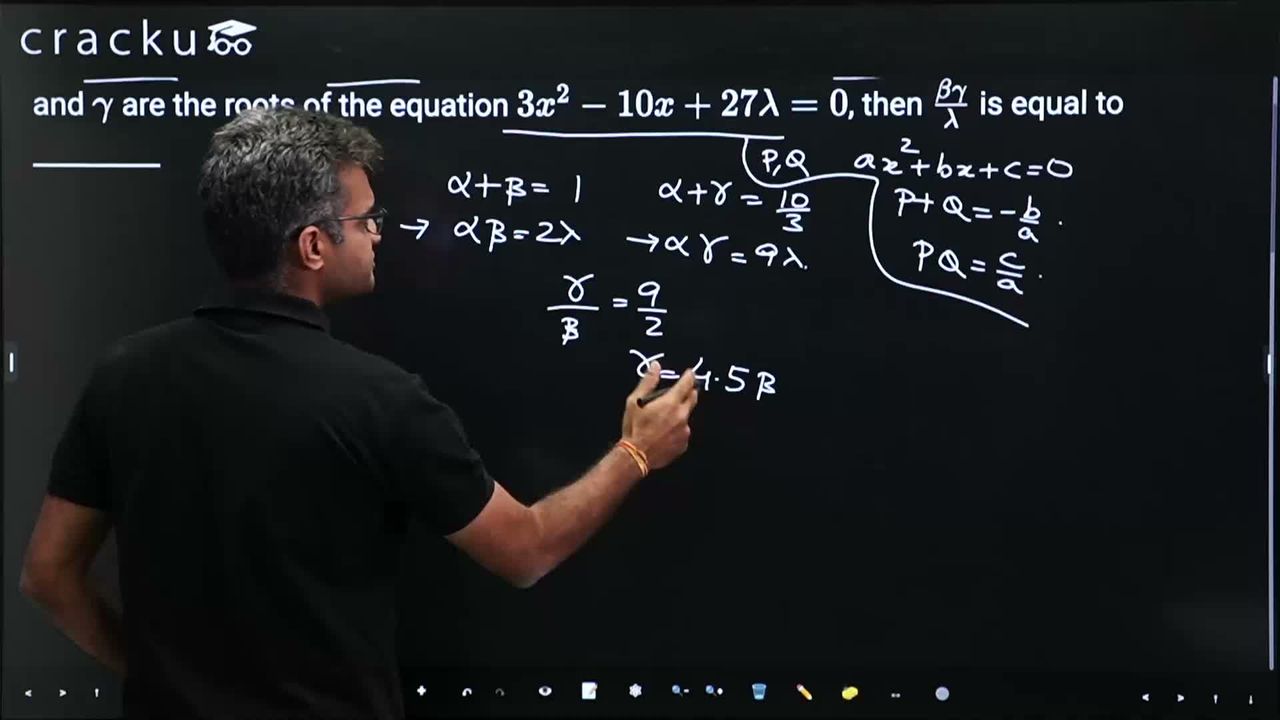
Applying this to the equation $$x^{2}-x+2\lambda=0$$ whose roots are $$\alpha$$ and $$\beta$$, we get $$\alpha+\beta=-\dfrac{-1}{1}=1$$ and $$\alpha\beta=\dfrac{2\lambda}{1}=2\lambda.$$ So $$\alpha+\beta=1,\qquad \alpha\beta=2\lambda. \quad -(1)$$
Next, apply the same formulas to $$3x^{2}-10x+27\lambda=0$$ whose roots are $$\alpha$$ and $$\gamma$$. Here $$a=3,\;b=-10,\;c=27\lambda$$, hence $$\alpha+\gamma=-\dfrac{-10}{3}=\dfrac{10}{3},\qquad \alpha\gamma=\dfrac{27\lambda}{3}=9\lambda.$$ Thus $$\alpha+\gamma=\dfrac{10}{3},\qquad \alpha\gamma=9\lambda. \quad -(2)$$
From the first sum, express $$\beta$$ as $$\beta=1-\alpha.$$ From the second sum, express $$\gamma$$ as $$\gamma=\dfrac{10}{3}-\alpha.$$
Now rewrite the two products from (1) and (2) using these expressions:
Using $$\beta=1-\alpha$$, $$\alpha\beta=\alpha(1-\alpha)=2\lambda. \quad -(3)$$
Using $$\gamma=\dfrac{10}{3}-\alpha$$, $$\alpha\gamma=\alpha\left(\dfrac{10}{3}-\alpha\right)=9\lambda. \quad -(4)$$
To eliminate $$\lambda$$, divide (4) by (3):
$$\dfrac{\alpha\left(\dfrac{10}{3}-\alpha\right)}{\alpha(1-\alpha)}=\dfrac{9\lambda}{2\lambda}\quad\Longrightarrow\quad\dfrac{\dfrac{10}{3}-\alpha}{1-\alpha}=\dfrac{9}{2}.$$
Cross-multiplying, $$2\!\left(\dfrac{10}{3}-\alpha\right)=9(1-\alpha).$$ Compute each side: Left side $$\;= \dfrac{20}{3}-2\alpha,$$ Right side $$= 9-9\alpha.$$ Equating, $$\dfrac{20}{3}-2\alpha = 9-9\alpha.$$
Move the terms involving $$\alpha$$ to one side: $$\dfrac{20}{3}+7\alpha = 9.$$ Subtract $$\dfrac{20}{3}$$ from both sides: $$7\alpha = 9-\dfrac{20}{3} = \dfrac{27}{3}-\dfrac{20}{3}=\dfrac{7}{3}.$$ Hence $$\alpha=\dfrac{\dfrac{7}{3}}{7}=\dfrac{1}{3}.$$
With $$\alpha=\dfrac{1}{3}$$, obtain the remaining roots: $$\beta = 1-\alpha = 1-\dfrac{1}{3}=\dfrac{2}{3},$$ $$\gamma = \dfrac{10}{3}-\alpha = \dfrac{10}{3}-\dfrac{1}{3}=3.$$
Compute the product $$\beta\gamma$$: $$\beta\gamma = \dfrac{2}{3}\times3 = 2.$$
Determine $$\lambda$$ from (3): $$\alpha\beta = 2\lambda\;\Longrightarrow\;\dfrac{1}{3}\times\dfrac{2}{3}=2\lambda\;\Longrightarrow\;\dfrac{2}{9}=2\lambda\;\Longrightarrow\;\lambda=\dfrac{1}{9}.$$
Finally, evaluate the required ratio: $$\dfrac{\beta\gamma}{\lambda} = \dfrac{2}{\dfrac{1}{9}} = 2 \times 9 = 18.$$
So, the answer is $$18$$.
Was this solution helpful?
Click on the Email ☝️ to Watch the Video Solution
Create a FREE account and get:
_1.webp)

Educational materials for JEE preparation

Ask our AI anything

AI can make mistakes. Please verify important information.
AI can make mistakes. Please verify important information.
