
Join Our JEE Preparation Group
Prep with like-minded aspirants; Get access to free daily tests and study material.
Sign in
Please select an account to continue using cracku.in
↓ →
Join Our JEE Preparation Group
Prep with like-minded aspirants; Get access to free daily tests and study material.
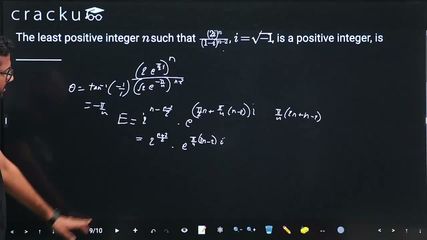
The least positive integer $$n$$ such that $$\frac{(2i)^n}{(1-i)^{n-2}}$$, $$i = \sqrt{-1}$$, is a positive integer, is _________
Correct Answer: 6
We have to find the smallest positive integer $$n$$ for which the complex-valued expression
$$\dfrac{(2i)^n}{(1-i)^{\,n-2}}$$
comes out to be a positive integer (a real number > 0).
First we separate magnitude and argument of every factor.
The numerator is $$ (2i)^n = 2^n i^n $$.
Here $$i = e^{\,i\pi/2}$$, so
$$ i^n = e^{\,i n\pi/2}. $$
Hence
$$ (2i)^n = 2^n\,e^{\,i n\pi/2}. $$
Now we treat the denominator. Write $$1-i$$ in polar form:
$$ 1-i = \sqrt2\left(\cos\!\bigl(-\tfrac{\pi}{4}\bigr)+i\sin\!\bigl(-\tfrac{\pi}{4}\bigr)\right)=\sqrt2\,e^{-\,i\pi/4}. $$
Therefore
$$ (1-i)^{\,n-2}= \bigl(\sqrt2\bigr)^{\,n-2}\,e^{-\,i(n-2)\pi/4}. $$
So the entire fraction becomes
$$ \dfrac{(2i)^n}{(1-i)^{\,n-2}} =\dfrac{2^n\,e^{\,i n\pi/2}}{\bigl(\sqrt2\bigr)^{\,n-2}\,e^{-\,i (n-2)\pi/4}} =2^n\bigl(\sqrt2\bigr)^{-(n-2)}\,e^{\,i\left(\dfrac{n\pi}{2}+\dfrac{(n-2)\pi}{4}\right)}. $$
We now simplify the magnitude (modulus).
Formula used: $$\bigl(\sqrt2\bigr)^{n-2}=2^{\,(n-2)/2}.$$ Substituting:
$$ 2^n \times 2^{-\,(n-2)/2}=2^{\,n-\frac{n-2}{2}}=2^{\,n-\frac{n}{2}+1}=2^{\,\frac{n}{2}+1}. $$
Thus the modulus of the fraction is $$2^{\,\frac{n}{2}+1}$$, clearly a positive real number for every positive integer $$n$$.
Next we handle the argument (angle). Adding the angles we obtained earlier, we have
$$ \text{Arg} = \dfrac{n\pi}{2} + \dfrac{(n-2)\pi}{4} = \dfrac{2n\pi + (n-2)\pi}{4} = \dfrac{(3n-2)\pi}{4}. $$
For the overall complex number to be a positive real, its argument must be an integral multiple of $$2\pi$$:
$$ \dfrac{(3n-2)\pi}{4}=2k\pi \quad\Longrightarrow\quad \dfrac{3n-2}{4}=2k \quad\Longrightarrow\quad 3n-2=8k, $$
where $$k$$ is any integer.
Rearranging,
$$ 3n = 8k+2. $$
We want the least positive $$n$$ that satisfies this linear Diophantine equation. Work modulo 3: $$8k+2\equiv (-1)k+2\pmod 3,$$ so we require
$$ (-1)k+2\equiv 0\pmod 3 \;\;\Longrightarrow\;\; k\equiv 2\pmod 3. $$
Put $$k=3m+2$$ with integer $$m\ge 0$$. Substituting back:
$$ 3n = 8(3m+2)+2 = 24m+16+2 = 24m+18 = 6(4m+3). $$
Hence
$$ n = 2(4m+3) = 8m+6. $$
The smallest value arises when $$m=0$$, giving
$$ n = 6. $$
For this $$n$$ the modulus is $$2^{\,\frac{6}{2}+1}=2^{\,4}=16$$, and the argument is zero, so the fraction equals $$16$$, a positive integer exactly as required.
Hence, the correct answer is Option 6.
Was this solution helpful?
Click on the Email ☝️ to Watch the Video Solution
Create a FREE account and get:
_1.webp)

Educational materials for JEE preparation

Ask our AI anything

AI can make mistakes. Please verify important information.
AI can make mistakes. Please verify important information.
