
Join Our JEE Preparation Group
Prep with like-minded aspirants; Get access to free daily tests and study material.
Sign in
Please select an account to continue using cracku.in
↓ →
Join Our JEE Preparation Group
Prep with like-minded aspirants; Get access to free daily tests and study material.
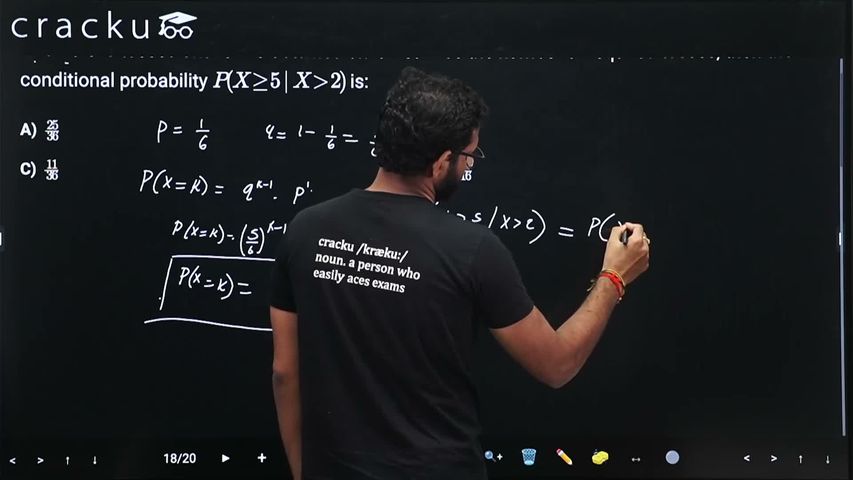
A fair die is tossed until six is obtained on it. Let $$X$$ be the number of required tosses, then the conditional probability $$P(X \geq 5 \mid X \gt 2)$$ is:
We have a fair die, so the probability of getting a six on any single toss is $$p=\dfrac16$$ and the probability of not getting a six is $$q=\dfrac56$$.
The random variable $$X$$ counts the number of tosses needed until the first six appears. Such a random variable follows the geometric distribution with parameter $$p=\dfrac16$$. For a geometric distribution we know the formula
$$P(X=k)=q^{\,k-1}\,p \quad (k=1,2,3,\ldots).$$
Another useful fact is the “tail” probability. To stay tossing for at least $$n$$ throws, the first $$n-1$$ throws must all be failures (i.e. not six), so
$$P(X\ge n)=q^{\,n-1}.$$
The question asks for the conditional probability
$$P(X\ge5\;|\;X\gt 2).$$
By the definition of conditional probability,
$$P(X\ge5\;|\;X\gt 2)=\dfrac{P(X\ge5\ \text{and}\ X\gt 2)}{P(X\gt 2)}.$$
Notice that the event $$X\ge5$$ automatically implies $$X\gt 2$$, so the intersection “$$X\ge5$$ and $$X\gt 2$$” is simply $$X\ge5$$ itself. Hence
$$P(X\ge5\;|\;X\gt 2)=\dfrac{P(X\ge5)}{P(X\ge3)}.$$
Now we evaluate both probabilities using the tail formula stated above.
First,
$$P(X\ge5)=q^{\,5-1}=q^{\,4}=\left(\dfrac56\right)^4=\dfrac{5^4}{6^4}=\dfrac{625}{1296}.$$
Next,
$$P(X\ge3)=q^{\,3-1}=q^{\,2}=\left(\dfrac56\right)^2=\dfrac{5^2}{6^2}=\dfrac{25}{36}.$$
Substituting these values into the conditional probability expression, we get
$$P(X\ge5\;|\;X\gt 2)=\dfrac{\dfrac{625}{1296}}{\dfrac{25}{36}} =\dfrac{625}{1296}\times\dfrac{36}{25}.$$
We now perform the algebraic simplification step by step. First cancel the common factor $$36$$ between numerator and denominator:
$$\dfrac{625}{1296}\times\dfrac{36}{25} =\dfrac{625}{36\cdot36}\times\dfrac{36}{25} =\dfrac{625}{36}\times\dfrac1{25}.$$
Multiplying the numerators and denominators gives
$$\dfrac{625}{36\times25}=\dfrac{625}{900}.$$
Finally, dividing both numerator and denominator by $$25$$ yields
$$\dfrac{625/25}{900/25}=\dfrac{25}{36}.$$
So the required conditional probability is
$$P(X\ge5\;|\;X\gt 2)=\dfrac{25}{36}.$$
Hence, the correct answer is Option A.
Was this solution helpful?
Click on the Email ☝️ to Watch the Video Solution
Create a FREE account and get:
_1.webp)

Educational materials for JEE preparation

Ask our AI anything

AI can make mistakes. Please verify important information.
AI can make mistakes. Please verify important information.
