
Join Our JEE Preparation Group
Prep with like-minded aspirants; Get access to free daily tests and study material.
Sign in
Please select an account to continue using cracku.in
↓ →
Join Our JEE Preparation Group
Prep with like-minded aspirants; Get access to free daily tests and study material.
Let $$P$$ be the plane passing through the point $$(1, 2, 3)$$ and the line of intersection of the planes $$\vec{r} \cdot (\hat{i} + \hat{j} + 4\hat{k}) = 16$$ and $$\vec{r} \cdot (-\hat{i} + \hat{j} + \hat{k}) = 6$$. Then which of the following points does NOT lie on $$P$$?
First, recall the standard way to write the equation of a plane that passes through the line of intersection of two planes. If the two given planes are $$\Pi_1 : a_1 x + b_1 y + c_1 z + d_1 = 0$$ and $$\Pi_2 : a_2 x + b_2 y + c_2 z + d_2 = 0,$$ then every plane through their line of intersection can be written as $$\Pi : (a_1 x + b_1 y + c_1 z + d_1) + \lambda (a_2 x + b_2 y + c_2 z + d_2) = 0,$$ where $$\lambda$$ is a real parameter.
Here the two planes are given in vector form. Converting the dot products into Cartesian equations, we have
$$\vec r \cdot (\hat i + \hat j + 4\hat k)=16 \;\Longrightarrow\; x + y + 4z = 16,$$ $$\vec r \cdot (-\hat i + \hat j + \hat k)=6 \;\Longrightarrow\; -x + y + z = 6.$$
So the general plane through their intersection is
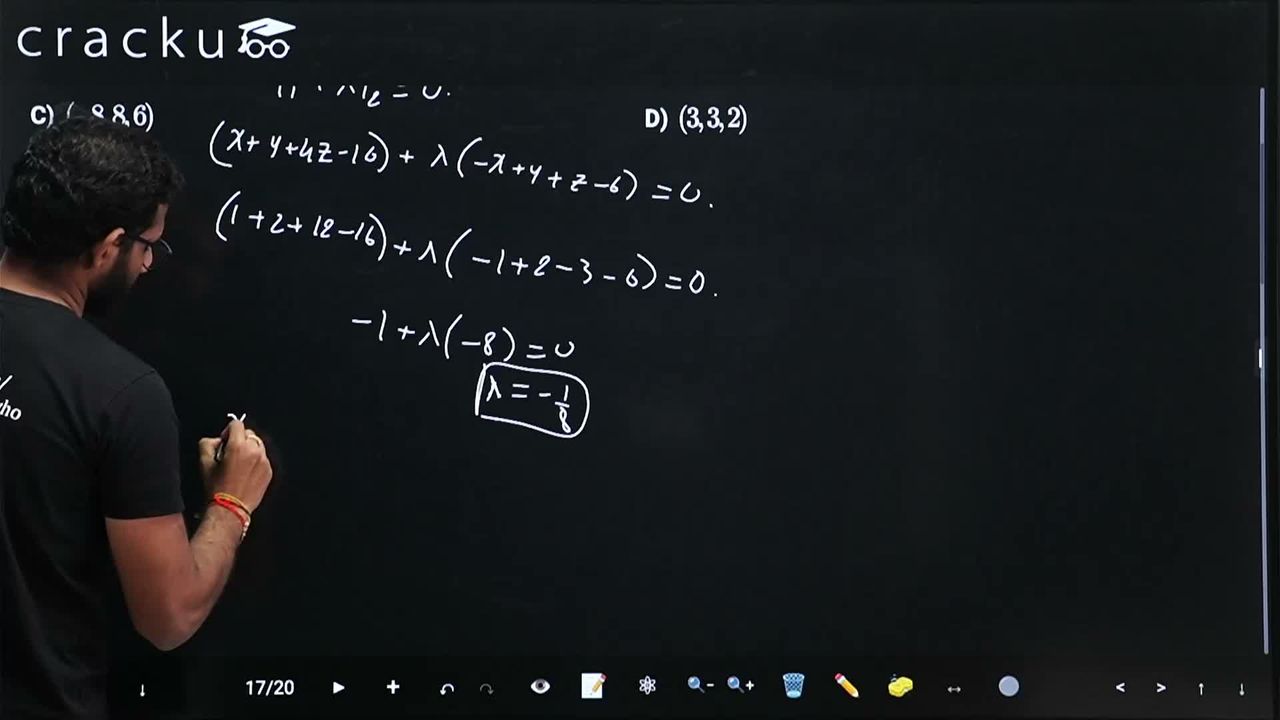
$$ (x + y + 4z - 16) + \lambda(-x + y + z - 6) = 0. $$
This plane must also pass through the specific point $$(1,\,2,\,3).$$ Substituting these coordinates, we obtain
$$ (1 + 2 + 4\cdot 3 - 16) + \lambda\bigl(-1 + 2 + 3 - 6\bigr) = 0.$$
Simplifying each bracket individually,
$$ 1 + 2 + 12 - 16 = -1, \qquad -1 + 2 + 3 - 6 = -2. $$
Hence
$$ -1 + \lambda(-2) = 0 \;\Longrightarrow\; -1 - 2\lambda = 0 \;\Longrightarrow\; 2\lambda = -1 \;\Longrightarrow\; \lambda = -\dfrac12. $$
Substituting $$\lambda = -\dfrac12$$ back into the general equation, we get
$$ (x + y + 4z - 16) - \dfrac12\bigl(-x + y + z - 6\bigr) = 0. $$
To clear the denominator, multiply the whole equation by 2:
$$ 2(x + y + 4z - 16) - (-x + y + z - 6) = 0. $$
Expanding both parts,
$$ 2x + 2y + 8z - 32 + x - y - z + 6 = 0. $$
Combining like terms,
$$ 3x + y + 7z - 26 = 0. $$
This is the required plane $$P$$.
Now we simply test each of the four given points by substituting their coordinates into $$3x + y + 7z - 26.$$ If the resulting value is zero, the point lies on the plane; otherwise, it does not.
For $$(4, 2, 2):$$ $$3(4) + 2 + 7(2) - 26 = 12 + 2 + 14 - 26 = 28 - 26 = 2 \neq 0.$$ So $$(4, 2, 2)$$ is not on the plane.
For $$(6, -6, 2):$$ $$3(6) + (-6) + 7(2) - 26 = 18 - 6 + 14 - 26 = 26 - 26 = 0.$$ Thus $$(6, -6, 2)$$ lies on the plane.
For $$(-8, 8, 6):$$ $$3(-8) + 8 + 7(6) - 26 = -24 + 8 + 42 - 26 = 26 - 26 = 0.$$ Hence $$(-8, 8, 6)$$ lies on the plane.
For $$(3, 3, 2):$$ $$3(3) + 3 + 7(2) - 26 = 9 + 3 + 14 - 26 = 26 - 26 = 0.$$ So $$(3, 3, 2)$$ also lies on the plane.
Only the point $$(4, 2, 2)$$ fails to satisfy the plane equation. Hence, the correct answer is Option A.
Was this solution helpful?
Click on the Email ☝️ to Watch the Video Solution
Create a FREE account and get:
_1.webp)

Educational materials for JEE preparation

Ask our AI anything

AI can make mistakes. Please verify important information.
AI can make mistakes. Please verify important information.
