
Join Our JEE Preparation Group
Prep with like-minded aspirants; Get access to free daily tests and study material.
Sign in
Please select an account to continue using cracku.in
↓ →
Join Our JEE Preparation Group
Prep with like-minded aspirants; Get access to free daily tests and study material.
A hall has a square floor of dimension 10 m $$\times$$ 10 m (see the figure) and vertical walls. If the angle GPH between the diagonals AG and BH is $$\cos^{-1}\frac{1}{5}$$, then the height of the hall (in meters) is:
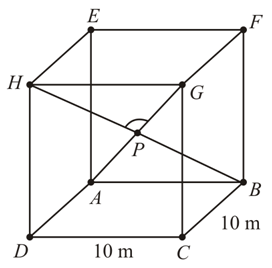
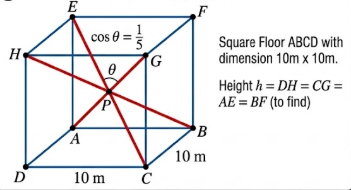
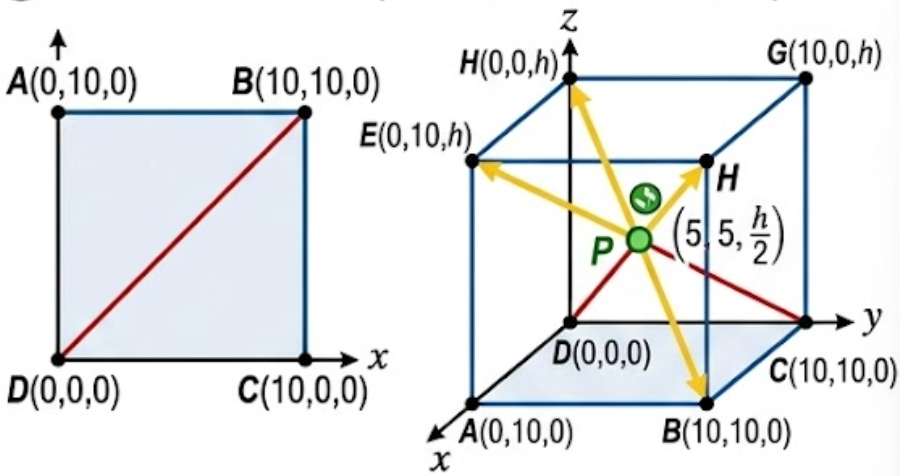
$$P = \left( \frac{0+10}{2}, \frac{10+0}{2}, \frac{h+0}{2} \right)$$
$$= \left( 5, 5, \frac{h}{2} \right)$$
$$\vec{PG} = G - P = (10, 0, h) - \left( 5, 5, \frac{h}{2} \right)$$
$$= \left( 5, -5, \frac{h}{2} \right)$$
$$\vec{PH} = H - P = (0, 0, h) - \left( 5, 5, \frac{h}{2} \right)$$
$$= \left( -5, -5, \frac{h}{2} \right)$$
Angle $$GPH = \theta$$, $$\cos \theta = \frac{1}{5}$$.
Use dot product rule:
$$\vec{PG} \cdot \vec{PH} = |\vec{PG}| |\vec{PH}| \cos \theta$$
$$(5)(-5) + (-5)(-5) + \frac{h}{2} \left( \frac{h}{2} \right) = \left( \sqrt{50 + \frac{h^2}{4}} \right)^2 \cdot \frac{1}{5}$$
$$-25 + 25 + \frac{h^2}{4} = \left( 50 + \frac{h^2}{4} \right) \cdot \frac{1}{5}$$
Multiply by 20:
$$5h^2 = 200 + h^2$$
$$4h^2 = 200$$
$$h^2 = 50$$
$$h = \sqrt{50} = 5 \cdot \sqrt{2}$$
Was this solution helpful?
Click on the Email ☝️ to Watch the Video Solution
Create a FREE account and get:
_1.webp)

Educational materials for JEE preparation

Ask our AI anything

AI can make mistakes. Please verify important information.
AI can make mistakes. Please verify important information.
