
Join Our JEE Preparation Group
Prep with like-minded aspirants; Get access to free daily tests and study material.
Sign in
Please select an account to continue using cracku.in
↓ →
Join Our JEE Preparation Group
Prep with like-minded aspirants; Get access to free daily tests and study material.
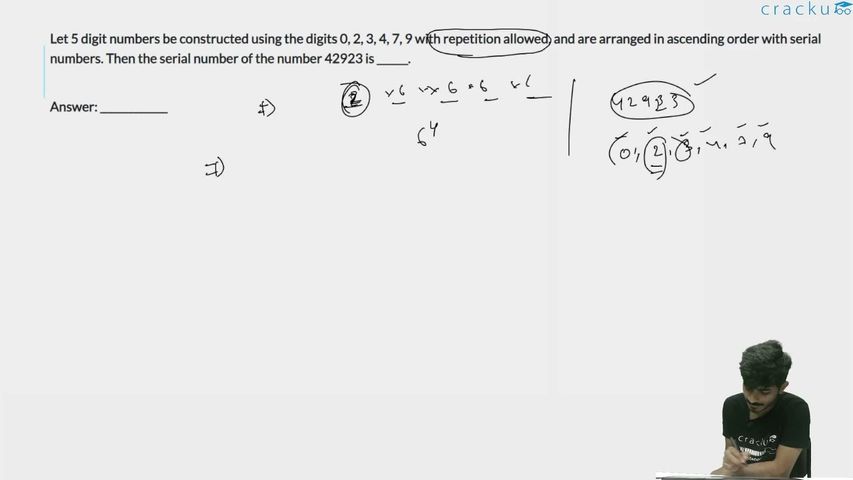
Let 5 digit numbers be constructed using the digits 0, 2, 3, 4, 7, 9 with repetition allowed, and are arranged in ascending order with serial numbers. Then the serial number of the number 42923 is ______.
Correct Answer: 2997
5-digit numbers using digits {0, 2, 3, 4, 7, 9} with repetition, arranged in ascending order. Find the serial number of 42923.
The digits in order: 0, 2, 3, 4, 7, 9. (6 digits total)
Numbers starting with digits less than 4 (i.e., 2 or 3):
(Can't start with 0 for 5-digit number)
Starting with 2: remaining 4 digits each from {0,2,3,4,7,9} = $$6^4 = 1296$$
Starting with 3: $$6^4 = 1296$$
Total: $$2 \times 1296 = 2592$$
Numbers starting with 4, second digit less than 2:
Second digit = 0: $$6^3 = 216$$
Numbers starting with 42, third digit less than 9:
Third digit $$\in \{0, 2, 3, 4, 7\}$$: $$5 \times 6^2 = 5 \times 36 = 180$$
Numbers starting with 429, fourth digit less than 2:
Fourth digit = 0: $$6^1 = 6$$
Numbers starting with 4292, fifth digit less than 3:
Fifth digit $$\in \{0, 2\}$$: 2 numbers
Total numbers less than 42923:
$$2592 + 216 + 180 + 6 + 2 = 2996$$
Serial number of 42923 = $$2996 + 1 = 2997$$.
The answer is $$\boxed{2997}$$.
Was this solution helpful?
Click on the Email ☝️ to Watch the Video Solution
Create a FREE account and get:
_1.webp)

Educational materials for JEE preparation

Ask our AI anything

AI can make mistakes. Please verify important information.
AI can make mistakes. Please verify important information.
