
Join Our JEE Preparation Group
Prep with like-minded aspirants; Get access to free daily tests and study material.
Sign in
Please select an account to continue using cracku.in
↓ →
Join Our JEE Preparation Group
Prep with like-minded aspirants; Get access to free daily tests and study material.
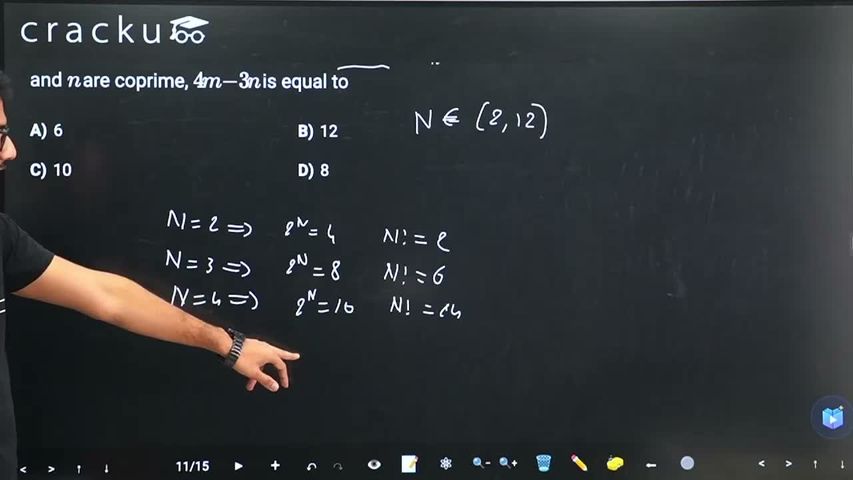
Let $$N$$ denote the sum of the numbers obtained when two dice are rolled. If the probability that $$2^N < N!$$ is $$\frac{m}{n}$$, where $$m$$ and $$n$$ are coprime, $$4m - 3n$$ is equal to
1. Analyze the condition $$2^N < N!$$
For the sum $$N$$ of two dice, $$N$$ can range from $$2$$ to $$12$$.
The condition $$2^N < N!$$ is true for all $$N \geq 4$$.
2. Calculate the Probability
The total number of outcomes when rolling two dice is $$36$$.
We need $$P(N \geq 4)$$, which is easier to calculate as $$1 - P(N < 4)$$.
Total outcomes for $$N < 4$$ is $$1 + 2 = 3$$.
$$P(N \geq 4) = 1 - \frac{3}{36} = 1 - \frac{1}{12} = \frac{11}{12}$$
Here, $$m = 11$$ and $$n = 12$$ (they are coprime).
3. Final Calculation
Substitute $$m$$ and $$n$$ into the expression $$4m - 3n$$:
$$4(11) - 3(12) = 44 - 36 = \mathbf{8}$$
Correct Option: (D)
Click on the Email ☝️ to Watch the Video Solution
Create a FREE account and get:
_1.webp)

Educational materials for JEE preparation

Ask our AI anything

AI can make mistakes. Please verify important information.
AI can make mistakes. Please verify important information.


