
Join Our JEE Preparation Group
Prep with like-minded aspirants; Get access to free daily tests and study material.
Sign in
Please select an account to continue using cracku.in
↓ →
Join Our JEE Preparation Group
Prep with like-minded aspirants; Get access to free daily tests and study material.
Let in a Binomial distribution, consisting of 5 independent trials, probabilities of exactly 1 and 2 successes be 0.4096 and 0.2048 respectively. Then the probability of getting exactly 3 successes is equal to :
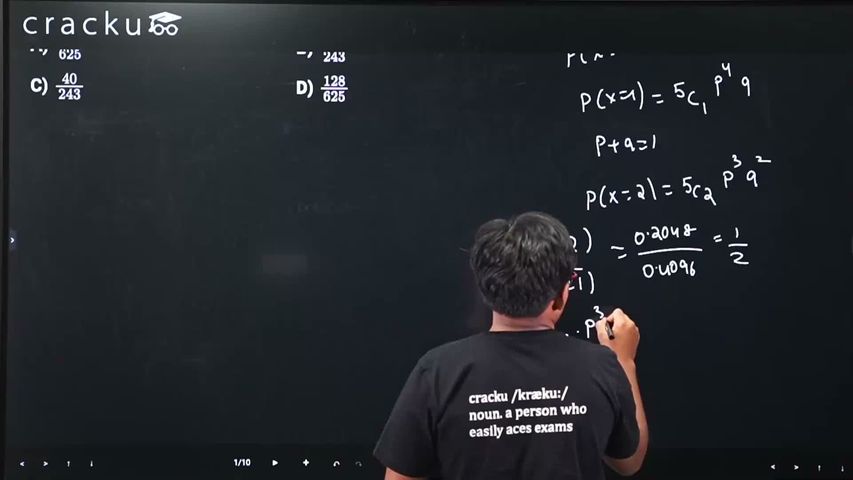
In a Binomial distribution with $$n = 5$$ trials, let the probability of success be $$p$$ and failure be $$q = 1 - p$$. We are given $$P(X=1) = \binom{5}{1}p\,q^4 = 5p\,q^4 = 0.4096$$ and $$P(X=2) = \binom{5}{2}p^2q^3 = 10p^2q^3 = 0.2048$$.
Dividing the second equation by the first: $$\dfrac{10p^2q^3}{5p\,q^4} = \dfrac{2p}{q} = \dfrac{0.2048}{0.4096} = \dfrac{1}{2}$$. This gives $$q = 4p$$. Substituting into $$p + q = 1$$ yields $$5p = 1$$, so $$p = \dfrac{1}{5}$$ and $$q = \dfrac{4}{5}$$.
We can verify: $$5 \cdot \dfrac{1}{5} \cdot \left(\dfrac{4}{5}\right)^4 = \dfrac{256}{625} = 0.4096$$ and $$10 \cdot \dfrac{1}{25} \cdot \dfrac{64}{125} = \dfrac{640}{3125} = 0.2048$$, both correct.
The probability of exactly 3 successes is $$P(X=3) = \binom{5}{3}p^3q^2 = 10 \cdot \dfrac{1}{125} \cdot \dfrac{16}{25} = \dfrac{160}{3125} = \dfrac{32}{625}$$.
Was this solution helpful?
Click on the Email ☝️ to Watch the Video Solution
Create a FREE account and get:
_1.webp)

Educational materials for JEE preparation

Ask our AI anything

AI can make mistakes. Please verify important information.
AI can make mistakes. Please verify important information.
