
Join Our JEE Preparation Group
Prep with like-minded aspirants; Get access to free daily tests and study material.
Sign in
Please select an account to continue using cracku.in
↓ →
Join Our JEE Preparation Group
Prep with like-minded aspirants; Get access to free daily tests and study material.
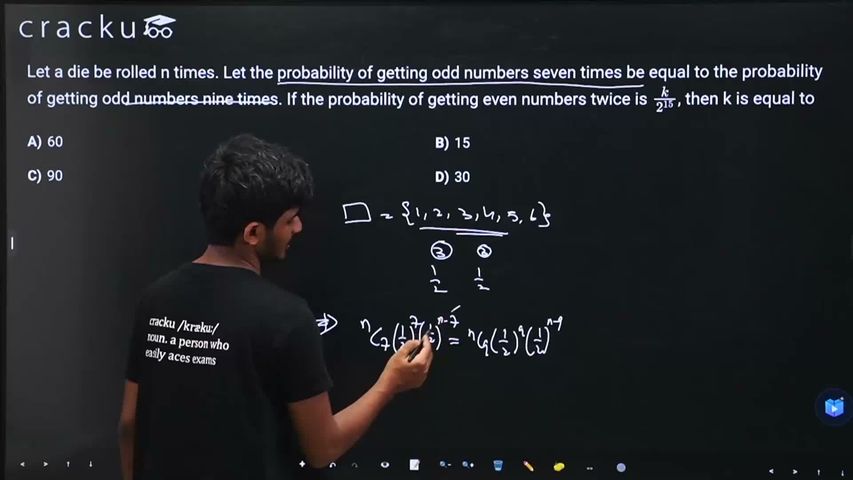
Let a die be rolled n times. Let the probability of getting odd numbers seven times be equal to the probability of getting odd numbers nine times. If the probability of getting even numbers twice is $$\frac{k}{2^{15}}$$, then k is equal to
Each roll of a fair die gives an odd number (1, 3, 5) with probability $$\tfrac12$$ and an even number (2, 4, 6) with probability $$\tfrac12$$.
Hence, when the die is rolled $$n$$ times, the number of odd outcomes, say $$X$$, follows the binomial distribution $$X \sim \text{Bin}(n,\tfrac12)$$.
The question says the probability of getting odd numbers exactly seven times equals the probability of getting them exactly nine times.
Using the binomial formula,
$$P(X=7)=\binom{n}{7}\left(\tfrac12\right)^{n}, \qquad P(X=9)=\binom{n}{9}\left(\tfrac12\right)^{n}$$
Equality of these probabilities gives
$$\binom{n}{7}=\binom{n}{9}$$
Divide the two combinations to remove the common factorial terms:
$$\frac{\binom{n}{9}}{\binom{n}{7}} =\frac{7!\,(n-7)!}{9!\,(n-9)!} =\frac{1}{9\cdot8}\,(n-7)(n-8)$$
Setting this ratio equal to 1 (because the two combinations are equal):
$$\frac{1}{9\cdot8}\,(n-7)(n-8)=1 \;\;\Longrightarrow\;\; (n-7)(n-8)=72$$
Expanding and solving the quadratic:
$$n^{2}-15n+56-72=0 \;\;\Longrightarrow\;\; n^{2}-15n-16=0$$
The positive root is
$$n=\frac{15+\sqrt{15^{2}+64}}{2} =\frac{15+17}{2} =16$$
Therefore, the die is rolled $$n=16$$ times.
Let $$Y$$ be the number of even outcomes. Because every roll is either odd or even, $$Y = n - X$$.
We need the probability of getting even numbers exactly twice, i.e. $$Y=2$$ when $$n=16$$.
Again using the binomial distribution (with probability $$\tfrac12$$ for an even number),
$$P(Y=2)=\binom{16}{2}\left(\tfrac12\right)^{16}$$
Calculate the combination:
$$\binom{16}{2}= \frac{16\cdot15}{2}=120$$
Thus
$$P(Y=2)=\frac{120}{2^{16}} =\frac{60}{2^{15}}$$
The given form of the probability is $$\dfrac{k}{2^{15}}$$, so $$k=60$$.
Hence, the required value of $$k$$ is 60.
Option A is correct.
Was this solution helpful?
Click on the Email ☝️ to Watch the Video Solution
Create a FREE account and get:
_1.webp)

Educational materials for JEE preparation

Ask our AI anything

AI can make mistakes. Please verify important information.
AI can make mistakes. Please verify important information.


