
Join Our JEE Preparation Group
Prep with like-minded aspirants; Get access to free daily tests and study material.
Sign in
Please select an account to continue using cracku.in
↓ →
Join Our JEE Preparation Group
Prep with like-minded aspirants; Get access to free daily tests and study material.
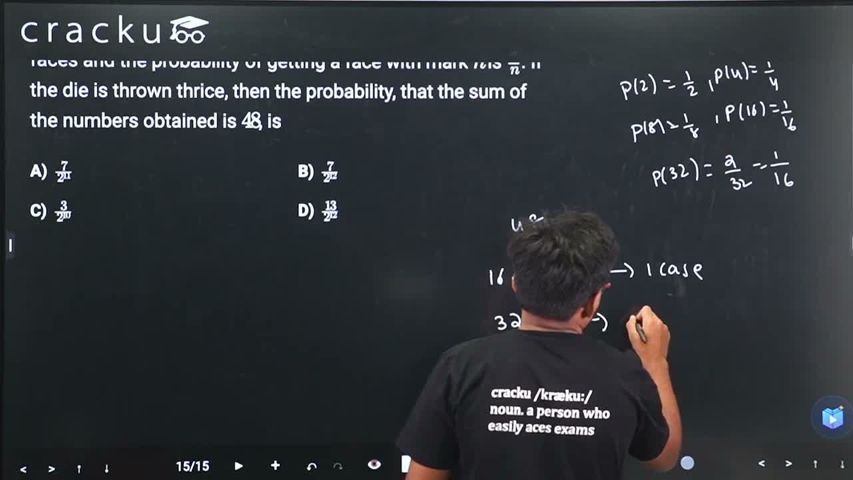
A biased die is marked with numbers $$2, 4, 8, 16, 32, 32$$ on its faces and the probability of getting a face with mark $$n$$ is $$\frac{1}{n}$$. If the die is thrown thrice, then the probability, that the sum of the numbers obtained is $$48$$, is
A biased die has faces marked $$2, 4, 8, 16, 32, 32$$ with $$P(\text{face } n) = \frac{1}{n}$$.
First, we find the individual probabilities: $$P(2) = \frac{1}{2}, \quad P(4) = \frac{1}{4}, \quad P(8) = \frac{1}{8}, \quad P(16) = \frac{1}{16}$$. Since $$32$$ appears on two faces, its probability is $$P(32) = \frac{1}{32} + \frac{1}{32} = \frac{1}{16}$$. Verification shows $$\frac{1}{2} + \frac{1}{4} + \frac{1}{8} + \frac{1}{16} + \frac{1}{16} = 1$$ ✓
Next, we look for all ways to obtain a sum of 48 in three throws by selecting numbers from $$\{2,4,8,16,32\}$$.
One way is $$(16,16,16)$$ since $$16 + 16 + 16 = 48$$. The probability of this sequence is $$\left(\frac{1}{16}\right)^3 = \frac{1}{4096}$$.
Another way is $$(32,8,8)$$ in any order, because $$32 + 8 + 8 = 48$$. There are $$\frac{3!}{2!} = 3$$ arrangements, giving a combined probability of $$3 \times \frac{1}{16} \times \frac{1}{8} \times \frac{1}{8} = \frac{3}{1024} = \frac{12}{4096}$$.
No other combinations work (for example, $$32 + 4 + 12$$ fails since 12 is not a face, and $$32 + 16 + 0$$ fails since 0 is not a face).
Therefore, the total probability is $$P = \frac{1}{4096} + \frac{12}{4096} = \frac{13}{4096} = \frac{13}{2^{12}}$$.
The answer is Option D: $$\frac{13}{2^{12}}$$.
Was this solution helpful?
Click on the Email ☝️ to Watch the Video Solution
Create a FREE account and get:
_1.webp)

Educational materials for JEE preparation

Ask our AI anything

AI can make mistakes. Please verify important information.
AI can make mistakes. Please verify important information.


