
Join Our JEE Preparation Group
Prep with like-minded aspirants; Get access to free daily tests and study material.
Sign in
Please select an account to continue using cracku.in
↓ →
Join Our JEE Preparation Group
Prep with like-minded aspirants; Get access to free daily tests and study material.
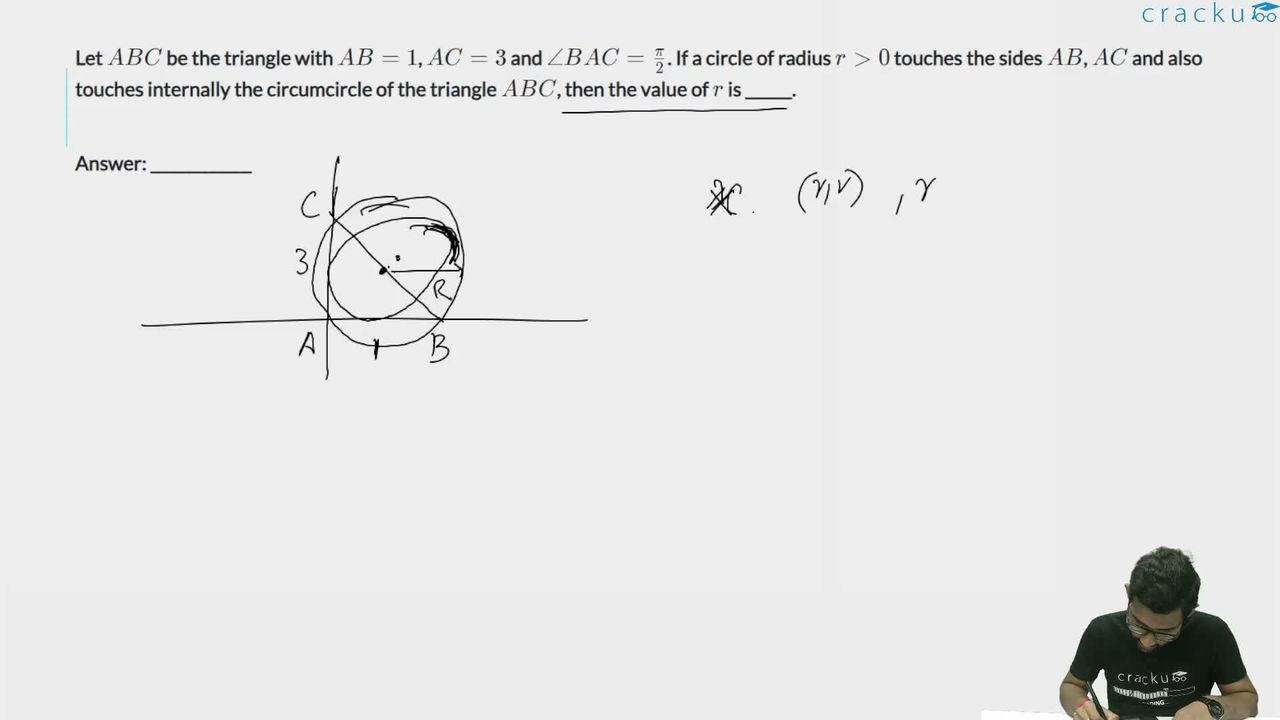
Let $$ABC$$ be the triangle with $$AB = 1$$, $$AC = 3$$ and $$\angle BAC = \frac{\pi}{2}$$. If a circle of radius $$r > 0$$ touches the sides $$AB$$, $$AC$$ and also touches internally the circumcircle of the triangle $$ABC$$, then the value of $$r$$ is ______.
Correct Answer: 0.83|0.84
Place the triangle on the coordinate plane so that the right angle is at the origin.
Let $$A(0,0)$$, $$B(1,0)$$ and $$C(0,3)$$. Thus $$AB=1$$, $$AC=3$$ and $$\angle BAC=\frac{\pi}{2}$$.
Step 1 : Circumcircle of $$\triangle ABC$$
For a right-angled triangle the hypotenuse is the diameter of the circumcircle.
Hence the circumcircle has
center $$O$$ = midpoint of $$BC = \left(\tfrac{1}{2},\tfrac{3}{2}\right)$$ and
radius $$R = \dfrac{BC}{2} = \dfrac{\sqrt{1^{2}+3^{2}}}{2} = \dfrac{\sqrt{10}}{2} = \sqrt{2.5}$$.
Step 2 : Coordinates of the required smaller circle
The required circle touches the positive $$x$$-axis (side $$AB$$) and the positive $$y$$-axis (side $$AC$$).
If its radius is $$r$$, its centre must therefore be $$P(r,r)$$, because the distance from $$P$$ to each axis must be $$r$$.
Step 3 : Condition for internal tangency with the circumcircle
For two circles with centres $$P$$ and $$O$$ and radii $$r$$ and $$R$$, internal tangency means
$$OP + r = R$$ $$-(1)$$
First compute $$OP$$:
$$OP = \sqrt{(r-0.5)^{2} + (r-1.5)^{2}}$$.
Substitute into $$(1)$$:
$$\sqrt{(r-0.5)^{2} + (r-1.5)^{2}} + r = \sqrt{2.5}$$.
Step 4 : Solve for $$r$$
Rearrange:
$$\sqrt{(r-0.5)^{2} + (r-1.5)^{2}} = \sqrt{2.5} - r.$$
Square both sides:
$$(r-0.5)^{2} + (r-1.5)^{2} = (\sqrt{2.5} - r)^{2}.$$
Compute each side:
Left side: $$(r^{2}-r+0.25) + (r^{2}-3r+2.25) = 2r^{2} - 4r + 2.5.$$
Right side: $$2.5 - 2r\sqrt{2.5} + r^{2}.$$
Set them equal:
$$2r^{2} - 4r + 2.5 = 2.5 - 2r\sqrt{2.5} + r^{2}.$$
Simplify:
$$r^{2} - 4r + 2r\sqrt{2.5} = 0.$$
Factor $$r$$:
$$r\bigl(r - 4 + 2\sqrt{2.5}\bigr) = 0.$$
Since $$r>0$$, we obtain
$$r = 4 - 2\sqrt{2.5}.$$
Step 5 : Numerical value
$$\sqrt{2.5} \approx 1.58114 \;\;\Longrightarrow\;\; r \approx 4 - 2(1.58114) \approx 4 - 3.16228 \approx 0.83772.$$
Rounded to two decimal places, $$r \approx 0.84$$. Accepting truncation gives $$0.83$$.
Hence the admissible values are 0.83 or 0.84.
Was this solution helpful?
Click on the Email ☝️ to Watch the Video Solution
Create a FREE account and get:
_1.webp)

Educational materials for JEE preparation

Ask our AI anything

AI can make mistakes. Please verify important information.
AI can make mistakes. Please verify important information.
