
Join Our JEE Preparation Group
Prep with like-minded aspirants; Get access to free daily tests and study material.
Sign in
Please select an account to continue using cracku.in
↓ →
Join Our JEE Preparation Group
Prep with like-minded aspirants; Get access to free daily tests and study material.
In the reported figure, there is a cyclic process $$ABCDA$$ on a sample of 1 mol of a diatomic gas. The temperature of the gas during the process $$A \rightarrow B$$ and $$C \rightarrow D$$ are $$T_1$$ and $$T_2$$ ($$T_1 > T_2$$) respectively.
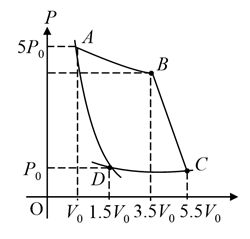
Choose the correct option out of the following for work done if processes $$BC$$ and $$DA$$ are adiabatic.
From the problem:
The work done during an adiabatic process depends purely on the temperature change of the gas:
$$W_{\text{adiabatic}} = \frac{nR(T_{\text{initial}} - T_{\text{final}})}{\gamma - 1}$$
$$W_{BC} = \frac{nR(T_1 - T_2)}{\gamma - 1}$$
$$W_{AD} = \frac{nR(T_1 - T_2)}{\gamma - 1}$$
Comparing both derived equations shows that the expressions are identical:
$$W_{AD} = W_{BC}$$
The calculation confirms that the work done along both paths matches exactly, making Option B ($$W_{AD} = W_{BC}$$) the correct choice.
Was this solution helpful?
Click on the Email ☝️ to Watch the Video Solution
Create a FREE account and get:
_1.webp)

Educational materials for JEE preparation

Ask our AI anything

AI can make mistakes. Please verify important information.
AI can make mistakes. Please verify important information.
