
Join Our JEE Preparation Group
Prep with like-minded aspirants; Get access to free daily tests and study material.
Sign in
Please select an account to continue using cracku.in
↓ →
Join Our JEE Preparation Group
Prep with like-minded aspirants; Get access to free daily tests and study material.
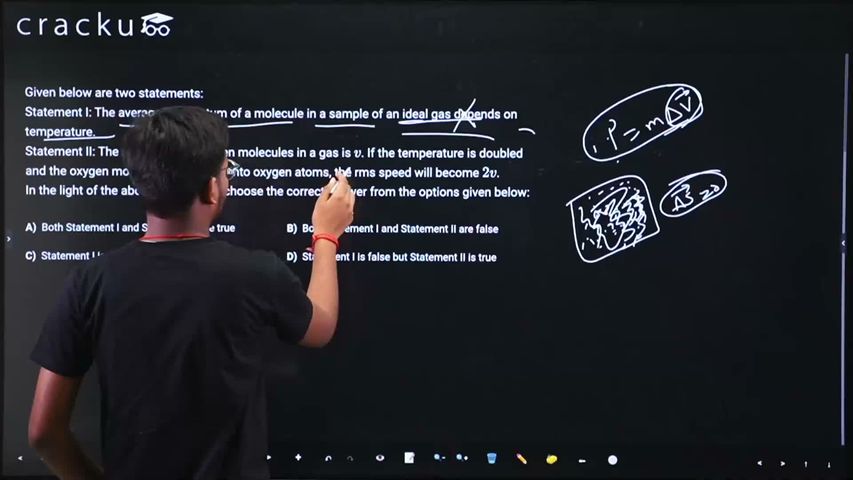
Given below are two statements:
Statement I: The average momentum of a molecule in a sample of an ideal gas depends on temperature.
Statement II: The rms speed of oxygen molecules in a gas is $$v$$. If the temperature is doubled and the oxygen molecules dissociate into oxygen atoms, the rms speed will become $$2v$$.
In the light of the above statements, choose the correct answer from the options given below:
We need to evaluate two statements about kinetic theory of gases.
Statement I: The average momentum of a molecule in a sample of an ideal gas depends on temperature.
The molecules in an ideal gas move randomly in all directions. While the average speed depends on temperature, the average velocity (and hence average momentum) is zero because the molecular motion is random and symmetric in all directions. Since the average momentum is always zero regardless of temperature, it does not depend on temperature.
Statement I is FALSE.
Statement II: If the temperature is doubled and O$$_2$$ molecules dissociate into O atoms, the rms speed becomes 2v.
The rms speed is given by:
$$v_{rms} = \sqrt{\frac{3RT}{M}}$$
Initially, for O$$_2$$ (molar mass $$M = 32$$ g/mol) at temperature $$T$$:
$$v = \sqrt{\frac{3RT}{32}}$$
After dissociation, we have O atoms (molar mass $$M' = 16$$ g/mol) at temperature $$2T$$:
$$v' = \sqrt{\frac{3R(2T)}{16}} = \sqrt{\frac{6RT}{16}} = \sqrt{\frac{3RT}{8}}$$
Taking the ratio:
$$\frac{v'}{v} = \sqrt{\frac{3RT/8}{3RT/32}} = \sqrt{\frac{32}{8}} = \sqrt{4} = 2$$
So $$v' = 2v$$.
Statement II is TRUE.
Hence, the correct answer is Option D: Statement I is false but Statement II is true.
Was this solution helpful?
Click on the Email ☝️ to Watch the Video Solution
Create a FREE account and get:
_1.webp)

Educational materials for JEE preparation

Ask our AI anything

AI can make mistakes. Please verify important information.
AI can make mistakes. Please verify important information.
