
Join Our JEE Preparation Group
Prep with like-minded aspirants; Get access to free daily tests and study material.
Sign in
Please select an account to continue using cracku.in
↓ →
Join Our JEE Preparation Group
Prep with like-minded aspirants; Get access to free daily tests and study material.
Each side of a box made of metal sheet in cubic shape is $$a$$ at room temperature $$T$$, the coefficient of linear expansion of the metal sheet is $$\alpha$$. The metal sheet is heated uniformly, by a small temperature $$\Delta T$$, so that its new temperature is $$T + \Delta T$$. Calculate the increase in the volume of the metal box.
We have a cubic metal box with each side of length $$a$$ at room temperature $$T$$. The coefficient of linear expansion of the metal sheet is $$\alpha$$. The temperature is increased by $$\Delta T$$.
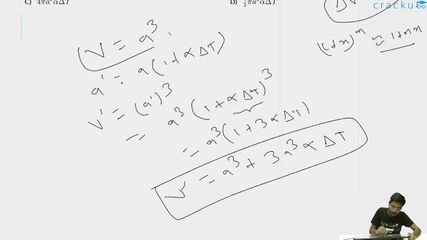
The initial volume of the cube is $$V_0 = a^3$$.
When the temperature increases by $$\Delta T$$, each side of the cube expands. The new length of each side is $$a' = a(1 + \alpha \Delta T)$$.
The new volume is $$V = (a')^3 = a^3(1 + \alpha \Delta T)^3$$.
Since $$\alpha \Delta T$$ is very small (the problem states "small temperature $$\Delta T$$"), we can use the binomial approximation $$(1 + x)^3 \approx 1 + 3x$$ for small $$x$$.
So $$V \approx a^3(1 + 3\alpha \Delta T) = a^3 + 3a^3\alpha \Delta T$$.
The increase in volume is $$\Delta V = V - V_0 = 3a^3\alpha \Delta T$$.
This result is consistent with the general formula for volume expansion: $$\Delta V = V_0 \gamma \Delta T$$, where the coefficient of volume expansion $$\gamma = 3\alpha$$ for isotropic materials.
Hence, the correct answer is Option B.
Was this solution helpful?
Click on the Email ☝️ to Watch the Video Solution
Create a FREE account and get:
_1.webp)

Educational materials for JEE preparation

Ask our AI anything

AI can make mistakes. Please verify important information.
AI can make mistakes. Please verify important information.


