
Join Our JEE Preparation Group
Prep with like-minded aspirants; Get access to free daily tests and study material.
Sign in
Please select an account to continue using cracku.in
↓ →
Join Our JEE Preparation Group
Prep with like-minded aspirants; Get access to free daily tests and study material.
A boy's catapult is made of rubber cord which is 42 cm long, with 6 mm diameter of cross-section and of negligible mass. The boy keeps a stone weighing 0.02 kg on it and stretches the cord by 20 cm by applying a constant force. When released, the stone flies off with a velocity of 20 ms$$^{-1}$$. Neglect the change in the area of cross-section of the cord while stretched. The Young's modulus of rubber is closest to:
Strain energy stored in the stretched rubber cord is
$$U=\frac{1}{2}\times \text{stress} \times \text{strain} \times \text{volume}$$
Using,
$$U=\frac{1}{2}\left(\frac{\Delta \ell}{\ell}\right)^2 Y A \ell$$
This stored energy converts into kinetic energy of the stone.
Hence,
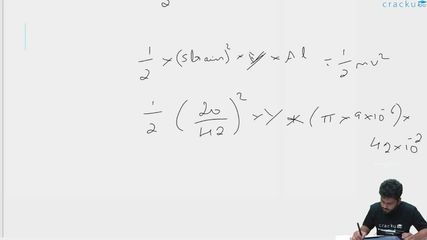
$$\frac{1}{2}\left(\frac{\Delta \ell}{\ell}\right)^2 Y A\ell = \frac{1}{2}mv^2$$
Given,
$$\ell=42\ \text{cm}=42\times10^{-2}\ \text{m}$$$$\Delta \ell=20\ \text{cm}=20\times10^{-2}\ \text{m}$$
Radius of cord,
$$r=3\ \text{mm}=3\times10^{-3}\ \text{m}$$
Area of cross-section,
$$A=\pi r^2=\pi(3\times10^{-3})^2$$
Mass of stone,
$$m=0.02\ \text{kg}=2\times10^{-2}\ \text{kg}$$
Velocity,
$$v=20\ \text{m s}^{-1}$$
Substituting,
$$\frac{1}{2}\left(\frac{20}{42}\right)^2 Y\times \pi(3\times10^{-3})^2 \times 42\times10^{-2} = \frac{1}{2}\times2\times10^{-2}\times(20)^2$$
Solving,
$$Y \approx 3\times10^6\ \text{N m}^{-2}$$
Hence,
$$\boxed{Y \approx 3\times10^6\ \text{N m}^{-2}}$$
Was this solution helpful?
Click on the Email ☝️ to Watch the Video Solution
Create a FREE account and get:
_1.webp)

Educational materials for JEE preparation

Ask our AI anything

AI can make mistakes. Please verify important information.
AI can make mistakes. Please verify important information.
