
Join Our JEE Preparation Group
Prep with like-minded aspirants; Get access to free daily tests and study material.
Sign in
Please select an account to continue using cracku.in
↓ →
Join Our JEE Preparation Group
Prep with like-minded aspirants; Get access to free daily tests and study material.
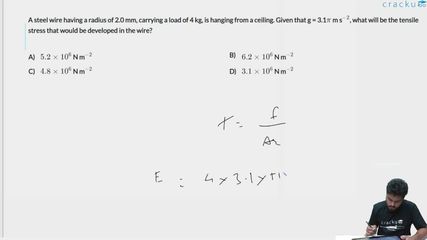
A steel wire having a radius of 2.0 mm, carrying a load of 4 kg, is hanging from a ceiling. Given that g = 3.1$$\pi$$ m s$$^{-2}$$, what will be the tensile stress that would be developed in the wire?
We have a vertical wire that is supporting a stationary load, so the force producing the stress is simply the weight of the load.
First, recall the definition of tensile stress.
$$\text{Tensile stress} \; (\sigma) \;=\; \dfrac{\text{Force}}{\text{Cross-sectional area}}$$
The force is the weight $$W$$ of the 4 kg mass. By Newton’s second law, weight is mass times acceleration due to gravity:
$$W \;=\; m\,g$$ where $$m = 4\ \text{kg}$$ and $$g = 3.1\pi\ \text{m s}^{-2}$$.
Substituting the numbers,
$$W \;=\; 4 \times (3.1\pi) \;=\; 12.4\pi\ \text{N}.$$
Next we need the cross-sectional area $$A$$ of the wire. The radius is given as 2.0 mm, so
$$r \;=\; 2.0\ \text{mm} \;=\; 2.0 \times 10^{-3}\ \text{m}.$$
For a circle, the area formula is
$$A \;=\; \pi r^{2}.$$
Substituting the value of $$r$$,
$$A \;=\; \pi \left(2.0 \times 10^{-3}\right)^{2} \;=\; \pi \left(4.0 \times 10^{-6}\right) \;=\; 4.0\pi \times 10^{-6}\ \text{m}^{2}.$$
Now we divide the force by the area to obtain the stress:
$$\sigma \;=\; \dfrac{W}{A} \;=\; \dfrac{12.4\pi}{4.0\pi \times 10^{-6}}.$$
The factor $$\pi$$ appears in both numerator and denominator, so it cancels out:
$$\sigma \;=\; \dfrac{12.4}{4.0} \times 10^{6} \;=\; 3.1 \times 10^{6}\ \text{N m}^{-2}.$$
Hence, the correct answer is Option D.
Was this solution helpful?
Click on the Email ☝️ to Watch the Video Solution
Create a FREE account and get:
_1.webp)

Educational materials for JEE preparation

Ask our AI anything

AI can make mistakes. Please verify important information.
AI can make mistakes. Please verify important information.
