
Join Our JEE Preparation Group
Prep with like-minded aspirants; Get access to free daily tests and study material.
Sign in
Please select an account to continue using cracku.in
↓ →
Join Our JEE Preparation Group
Prep with like-minded aspirants; Get access to free daily tests and study material.
Four identical particles of mass M are located at the corners of a square of side 'a'. What should be their speed if each of them revolves under the influence of other's gravitational field in a circular orbit circumscribing the square?
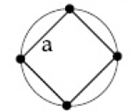
We place the four identical particles at the corners of a square ABCD of side $$a$$. Each particle has mass $$M$$ and all of them are made to revolve together, keeping the square rigid, about the centre $$O$$ of the square. Because they keep their relative positions unchanged, every particle describes a circle whose centre is $$O$$ and whose radius is the distance from a corner to the centre.
The diagonal of the square is $$a\sqrt 2$$, so half of this diagonal gives the radius of the circular path,
$$R=\dfrac{a\sqrt 2}{2}=\dfrac{a}{\sqrt 2}.$$
We now pick one particle, say the one at corner A. It experiences gravitational attraction from the three remaining particles situated at B, C and D. According to Newton’s law of gravitation, the magnitude of the gravitational force exerted by a particle of mass $$M$$ on another particle of mass $$M$$ separated by a distance $$r$$ is
$$F=\dfrac{G M^2}{r^2},$$
where $$G$$ is the universal gravitational constant.
1. Attraction by the two adjacent particles B and D • Distance AB = AD = $$a$$ • Magnitude of each force
$$F_1=\dfrac{G M^2}{a^2}.$$
These two forces act along AB and AD, which are perpendicular to each other. The direction OA (from A towards the centre O) bisects the right angle at A, therefore it makes an angle of $$45^{\circ}$$ with each side. Resolving each adjacent force towards the centre, we obtain the radial component
$$F_{1r}=F_1\cos45^{\circ}=F_1\dfrac{1}{\sqrt 2}.$$
Because there are two identical adjacent forces, the total radial pull supplied by them is
$$F_{adj}=2F_{1r}=2F_1\dfrac{1}{\sqrt 2}=\sqrt 2\,F_1.$$
(The tangential components cancel each other because they are equal in magnitude and opposite in direction.)
2. Attraction by the particle at the opposite corner C • Distance AC (full diagonal) $$=a\sqrt 2$$ • Magnitude of the force
$$F_2=\dfrac{G M^2}{(a\sqrt 2)^2}=\dfrac{G M^2}{2a^2}=\dfrac{F_1}{2}.$$
This force acts exactly along the diagonal AC, i.e. along AO, hence it is already directed towards the centre and needs no resolution.
Therefore the net gravitational force on the particle at A directed towards the centre is
$$F_{\text{net}}=F_{adj}+F_2=\sqrt 2\,F_1+\dfrac{F_1}{2}=\left(\sqrt 2+\dfrac12\right)F_1.$$
Substituting $$F_1=\dfrac{G M^2}{a^2}$$ gives
$$F_{\text{net}}=\left(\sqrt 2+\dfrac12\right)\dfrac{G M^2}{a^2}.$$
For uniform circular motion, the required centripetal force is provided exactly by this net inward force. The centripetal force needed for a particle of mass $$M$$ moving with speed $$v$$ in a circle of radius $$R$$ is
$$F_c=M\dfrac{v^2}{R}.$$
Equating the two forces,
$$M\dfrac{v^2}{R}=\left(\sqrt 2+\dfrac12\right)\dfrac{G M^2}{a^2}.$$
We cancel one factor of $$M$$ from both sides and substitute $$R=\dfrac{a}{\sqrt 2}$$:
$$\dfrac{v^2}{a/\sqrt 2}=\left(\sqrt 2+\dfrac12\right)\dfrac{G M}{a^2}.$$
Multiplying both sides by $$\dfrac{a}{\sqrt 2}$$ gives
$$v^2=\dfrac{1}{\sqrt 2}\left(\sqrt 2+\dfrac12\right)\dfrac{G M}{a}.$$
Simplify the numerical factor:
$$\dfrac{1}{\sqrt 2}\left(\sqrt 2+\dfrac12\right)=\dfrac{\sqrt 2}{\sqrt 2}+\dfrac{1}{2\sqrt 2}=1+\dfrac{1}{2\sqrt 2}.$$
The term $$\dfrac{1}{2\sqrt 2}\approx0.3536$$, so the bracket equals $$1.3536$$. Hence
$$v^2\approx1.3536\,\dfrac{G M}{a}.$$
Taking the square root,
$$v\approx1.16\,\sqrt{\dfrac{G M}{a}}.$$
This numerical coefficient (1.16 rounded to two decimal places) matches option D.
Hence, the correct answer is Option D.
Was this solution helpful?
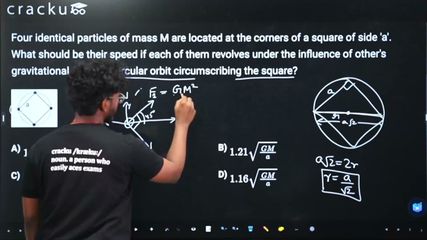
Click on the Email ☝️ to Watch the Video Solution
Create a FREE account and get:
_1.webp)

Educational materials for JEE preparation

Ask our AI anything

AI can make mistakes. Please verify important information.
AI can make mistakes. Please verify important information.
