
Join Our JEE Preparation Group
Prep with like-minded aspirants; Get access to free daily tests and study material.
Sign in
Please select an account to continue using cracku.in
↓ →
Join Our JEE Preparation Group
Prep with like-minded aspirants; Get access to free daily tests and study material.
The coefficients $$a, b$$ and $$c$$ of the quadratic equation, $$ax^2 + bx + c = 0$$ are obtained by throwing a dice three times. The probability that this equation has equal roots is:
The coefficients $$a, b, c$$ are each obtained by throwing a dice, so each takes values from $$\{1, 2, 3, 4, 5, 6\}$$. The total number of outcomes is $$6^3 = 216$$.
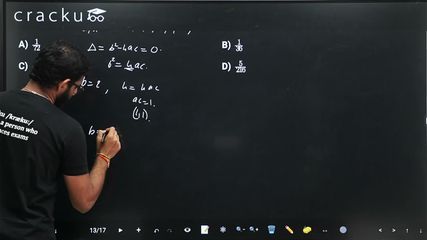
For the quadratic $$ax^2 + bx + c = 0$$ to have equal roots, the discriminant must be zero, i.e., $$b^2 - 4ac = 0$$, which gives $$b^2 = 4ac$$.
We now enumerate all valid $$(a, b, c)$$ with $$a, b, c \in \{1, 2, 3, 4, 5, 6\}$$ satisfying $$b^2 = 4ac$$.
If $$b = 2$$, then $$4 = 4ac$$, so $$ac = 1$$. The only possibility is $$(a, c) = (1, 1)$$. That gives 1 case.
If $$b = 4$$, then $$16 = 4ac$$, so $$ac = 4$$. The pairs $$(a, c)$$ with values in $$\{1, 2, 3, 4, 5, 6\}$$ are: $$(1, 4), (2, 2), (4, 1)$$. That gives 3 cases.
If $$b = 6$$, then $$36 = 4ac$$, so $$ac = 9$$. The only valid pair is $$(3, 3)$$, since $$(1, 9)$$ or $$(9, 1)$$ are out of range. That gives 1 case.
For odd values of $$b$$ (i.e., $$b = 1, 3, 5$$), $$b^2$$ is odd, but $$4ac$$ is always even, so no solutions exist.
The total number of favourable outcomes is $$1 + 3 + 1 = 5$$.
Therefore, the required probability is $$\frac{5}{216}$$.
Was this solution helpful?
Click on the Email ☝️ to Watch the Video Solution
Create a FREE account and get:
_1.webp)

Educational materials for JEE preparation

Ask our AI anything

AI can make mistakes. Please verify important information.
AI can make mistakes. Please verify important information.
